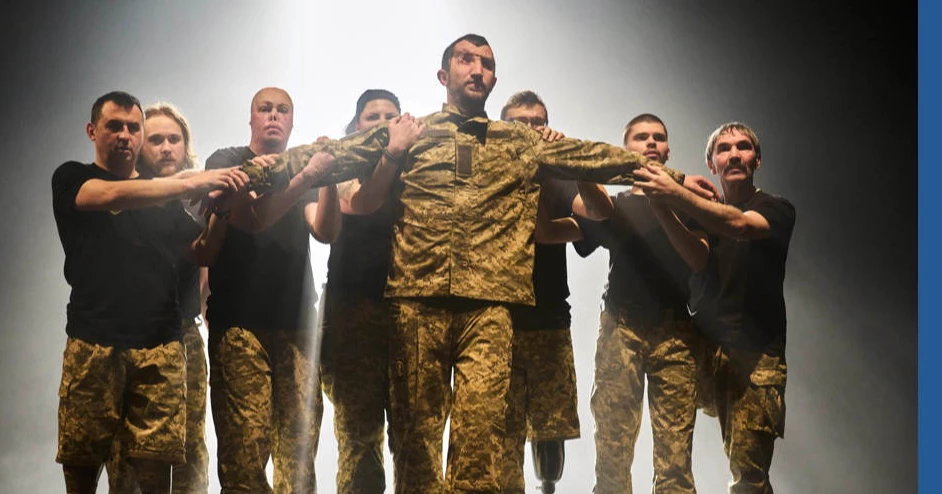
In war-hit Kyiv, wounded Ukrainian veterans are turning classic poetry into a powerful stage performance that reflects their own wartime experiences and resilience.
The play, directed by Olha Semioshkina, is based on “Eneida” by Ivan Kotliarevskyi, an 18th-century adaptation of Virgil’s epic. With the war nearing its fourth year after Russia’s full-scale invasion, the production blends myth with modern reality.
The cast includes veterans in their 20s to 60s who returned from the front with amputations, severe burns and vision loss, as well as civilians affected by the conflict. Many had never acted before. It took over a year of preparation for the premiere at the National Academic Molodyy Theatre.
Semioshkina said the team first focused on basic movement and communication, even practicing without prosthetic limbs to help actors reconnect with their bodies. Her idea was simple: every man represents Aeneas and every woman represents Dido — symbols of struggle, loss and the search for home.
During rehearsals, veteran Yehor Babenko, who suffered severe burns early in the invasion, used humor while delivering lines that echoed his own injuries. He said theatre has helped him heal both mentally and physically, boosting confidence and self-expression.
In the final act, actors step out of character to share their real stories — from losing limbs in drone attacks to living under occupation. Veteran medic Andrii Onopriienko, who lost his sight in an artillery strike near Avdiivka in 2023, narrated much of the performance in a deep voice, later joining the cast in song.
The realities of war were never far away. Before the show, audiences were warned about possible air raid sirens and blackouts. During one performance, the power went out, but actors continued using flashlights as the audience stayed, some in tears.
The cast received a standing ovation when the curtain fell, underscoring the play’s message of courage and hope. Semioshkina urged veterans watching from home to step forward, live fully and stay connected despite the scars of war.