Others

Overcoming body dysmorphia: stories of self-acceptance
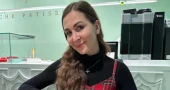
Charlotte and Tilly, two young women, have shared their journeys of overcoming Body Dysmorphic Disorder (BDD), a mental health condition marked by obsessive concern over perceived physical flaws that disrupt daily life.
Charlotte said her struggle began in early teens, with compulsive routines such as waking at 5:30 am to apply and remove makeup repeatedly. Her fear of being photographed and social anxiety led her to skip college events and isolate herself. She was later diagnosed with BDD and underwent therapy, including a residential program for anxiety disorders in London. Occupational therapy and creative activities like music helped her channel perfectionism and rebuild self-esteem.
Experts, including Viren Swami of Anglia Ruskin University, explained that BDD differs from general body dissatisfaction as it significantly interferes with everyday life, often causing repetitive behaviours such as mirror checking and distress over minor perceived flaws. While more common in women, BDD affects all genders and requires professional support.
Tilly, who also developed BDD in her early teens, recalled feeling ashamed of her appearance and avoiding social events. Her symptoms intensified while studying fashion design at university. Through NHS therapy and support from the BDD Foundation, she learned to manage obsessive thoughts and gradually regained control over her life.
Both women now advocate for awareness and early intervention. Charlotte emphasizes that recovery is possible, stating: “I feel so fulfilled and so happy and so peaceful, and I really do love my life now.” Tilly echoes that support and patience are crucial, as BDD often requires long-term professional help.
Mental health specialists advise anyone experiencing BDD symptoms to consult a GP and seek therapy, while friends and family are urged to respond with empathy rather than frustration. Organizations such as the BDD Foundation provide guidance and support for those affected.
For further information and support, individuals are encouraged to visit BBC Action Line.
With inputs from BBC
3 days ago

Study challenges idea that women are naturally more empathetic than men
Scientific research is challenging the long-held belief that women are naturally more empathetic than men, suggesting that socialisation and environment play a major role in shaping empathy.
While women often score slightly higher on empathy tests, experts say the difference is small and varies widely among individuals. Studies show that only about 10% of variation in empathy is due to genetics, with the remainder influenced by upbringing, societal expectations, and personal experiences.
Researchers note that girls are often encouraged from a young age to be nurturing and sensitive, while boys are socialised to prioritise independence and assertiveness. Hormonal factors, such as prenatal testosterone exposure, may influence tendencies toward systemising or empathising, but they do not fully determine empathy.
Empathy is also malleable and can be developed through motivation, reflection, and learning, experts say. Men’s empathy levels, for example, can improve when societal expectations encourage caring and emotional awareness.
The findings highlight how gender stereotypes about emotional traits can affect leadership, workplace dynamics, and personal relationships, while emphasising that empathy is a dynamic skill, not a fixed trait.
With inputs from BBC
4 days ago

An overview of Ramadan and how Muslims observe the sacred month
Muslims around the world are preparing to observe Ramadan, the Islamic holy month marked by daily fasting from dawn until sunset. For the faithful, it is a period of intensified worship, spiritual reflection and charitable giving. It is also a socially significant time, as families and friends gather in the evenings to share meals that break the fast.
Ramadan concludes with the celebration of Eid al-Fitr, one of Islam’s major holidays.
Ramadan likely to begin around Feb. 18-19
Ramadan is the ninth month of the Islamic lunar calendar, which rotates through the seasons. Its beginning is traditionally determined by the sighting of the crescent moon.
This year, Ramadan is expected to start on or about Feb. 18 or 19, although the exact date may vary from country to country. Differences arise because Islamic authorities worldwide may rely on moon sightings or distinct calculation methods to announce the start of the month.
Notably, Ramadan this year is expected to commence around the same time as Ash Wednesday, which marks the beginning of Lent, a solemn season of fasting and repentance for Catholics and many other Christians.
Fasting as a core pillar of Islam
Fasting during Ramadan is one of Islam’s Five Pillars, alongside the declaration of faith, daily prayers, almsgiving and pilgrimage to Mecca.
Muslims view fasting as both an act of devotion and a means of developing greater piety and self-discipline. Observers say it teaches patience, fosters gratitude and deepens empathy for those facing poverty and hunger.
Throughout Ramadan, Muslims abstain from all food and drink — including water — between dawn and sunset. The fast is broken at sunset with a meal known as iftar. Before dawn, many eat a pre-fast meal called suhoor to prepare for the day ahead.
Mosques typically see increased attendance, with worshippers engaging in congregational prayers, recitation of the Quran and extended periods of contemplation.
Charitable acts are especially emphasized. Many people distribute food packages, sponsor iftar meals for those in need or take part in community dinners that offer free meals.
Who is exempt from fasting
Islam provides exemptions for individuals who are unable to fast due to valid reasons such as illness or travel. Those who miss fasts for temporary reasons are generally required to make up the missed days later.
Cultural expressions and social traditions
While fasting is a religious obligation, many customs associated with Ramadan are shaped by local culture. Traditions differ across regions, though communal gatherings after sunset are a common feature.
Some families decorate their homes with Ramadan-themed ornaments and table settings, and markets and special bazaars often see increased activity.
In Egypt, the month takes on a festive atmosphere. Colorful lanterns adorn homes and streets, and traditional songs welcome the arrival of Ramadan. A long-standing custom involves a “mesaharati” walking through neighborhoods before dawn, beating a drum and calling out to residents to wake them for suhoor.
Television programming also plays a prominent role in some countries, with new drama series released during the month and advertisers competing for audiences. While some Muslims express concern that commercial activities and lavish iftar gatherings may overshadow the spiritual focus of Ramadan, others believe a balance can be maintained.
In Indonesia, Ramadan practices reflect regional diversity. In Aceh province, for example, families observe Meugang by slaughtering livestock and sharing meat with relatives and the needy. In Tangerang, near Jakarta, residents gather at the Cisadane River for a symbolic cleansing ritual before the month begins. In parts of Sumatra, children and teenagers parade through the streets after evening prayers, carrying torches and singing Islamic songs.
In the United States, where Muslims represent a diverse minority, many families attend iftar meals and prayers at mosques and Islamic centers to strengthen communal bonds. Interfaith iftar gatherings are also organized in some communities to promote understanding and solidarity.
Across cultures and continents, Ramadan remains a time of devotion, generosity and shared experience for Muslims worldwide.
6 days ago

Tech-themed fair showcases dancing robots for Lunar New Year
As China prepares to welcome the Lunar New Year, it’s not only people gearing up for the festivities — robots are joining the celebration as well.
On Friday, four small humanoid robots, each standing about 95 centimeters (3 feet) tall, rehearsed at a shopping mall in western Beijing, drawing the attention of curious shoppers.
Dressed in bright lion dance costumes, the robots quickly began performing: bending their knees, shifting left and right, lifting up, shaking their masks, and repeating the sequence in rhythm.
With the Lunar New Year approaching next week, venues across Beijing are busy preparing stages and decorations for a series of holiday fairs and events.
For the second consecutive year, one fair will highlight technology, with robots once again playing a leading role.
Visitors will be able to watch the robots dance, stack blocks into small towers, skewer syrup-coated hawthorn berries — a traditional sweet treat — and even play soccer.
Qiu Feng, a member of the organizing committee, said the number of participating robots has grown significantly this year. They are set to showcase a range of performances, including dance, martial arts, Peking Opera, poetry recitals and soccer matches.
While some activities were featured last year, Qiu noted that this year’s robots demonstrate smoother movements and a stronger high-tech feel.
China has been intensifying efforts to develop more advanced robots capable of performing diverse tasks with the help of artificial intelligence and reduced human control.
Despite their progress, the robots still rely on human assistance at times — such as for dressing them or repositioning them if they stop unexpectedly during a mini soccer game.
Qiu added that as technology advances rapidly, the fair aims to keep pace and continue evolving alongside these innovations.
The robots appearing at the mall were created by Chinese startups, including Booster Robotics. The company plans to present around 20 humanoid robots that will perform dances and play soccer.
Ren Zixin, marketing director at Booster Robotics, explained that the robots operate in an AI-driven environment. Once a whistle signals the start, remote controls are set aside, and the robots independently handle their own decision-making and movement.
7 days ago

200 WWII love letters found in Nashville home now available online
More than 200 love letters exchanged by a couple during World War II have been digitally published by the Nashville Public Library, offering a deeply personal glimpse into love, uncertainty and hope during wartime.
The letters, written by William Raymond “Ray” Whittaker and Jane Dean, were discovered in a Nashville home that once belonged to Jane and her siblings. The collection was donated to the Metro Nashville Archives in 2016.
Ray, originally from New Rochelle, New York, came to Nashville to study at the historically Black Meharry Medical College, where he met Jane, also a student. They later lost contact when Ray left the city. In 1942, after being drafted into the Army and stationed at Fort Huachuca in Arizona, Ray reached out to Jane, who was then working as a medical lab technician at Vanderbilt University.
Although the archive does not have Ray’s first letter, it includes Jane’s reply dated July 30, 1942. Addressing him formally as “Dear Wm R.,” she wrote that hearing from him was both a “pleasant and sad surprise.” She said she was proud of his service but worried about the uncertainties of war. She ended the letter warmly, urging him to “Write, wire or call me real soon — Lovingly Jane.”
China’s Lunar New Year travel rush begins, 9.5 billion trips expected
According to metropolitan archivist Kelley Sirko, the letters provide an intimate look at two ordinary people navigating extraordinary times. “You really can’t help but smile,” Sirko said, noting how the correspondence reflects not just romance but also the realities of racial segregation, gender roles and military life.
As the letters continued, their relationship grew stronger. Ray, later assigned to help organize the segregated 92nd Infantry Division in Alabama, hinted at marriage. In one letter, he joked that as an officer he would earn more money if married and needed someone to help him spend it.
Jane initially questioned whether his feelings were genuine or driven by loneliness. But Ray soon wrote more seriously about wanting a future together.
The couple married on Nov. 7, 1942, in Birmingham. In a letter two days later, Jane addressed Ray as “my darling husband,” expressing joy in their marriage despite being separated by war.
The collection also includes photographs and Ray’s Alpha Phi Alpha fraternity patch. Archivists have not located any living relatives. Ray died in Nashville in 1989.
9 days ago
Thousands of Orchids light up Chicago Botanic Garden this winter
While snow covers the grounds of the Chicago Botanic Garden and the sky stays gray, a bright and colorful scene awaits visitors inside.
The garden is set to open its 12th annual Orchid Show on Saturday, featuring more than 10,000 blooming orchids. Inside the greenhouses, warm air and bright lights welcome guests as staff make final preparations.
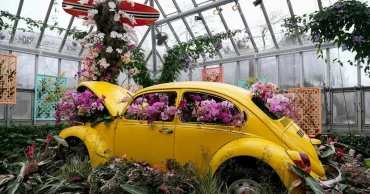
This year’s show is themed “Feelin’ Groovy,”inspired by the 1970s. One of the main attractions is a yellow Volkswagen Beetle filled with orchids, adding a fun and cheerful touch to the display.
“It’s a great escape from the winter cold,” said Jodi Zombolo, associate vice president of visitor events and programs. “People are looking for something joyful and playful during this time of year.”
Orchids are one of the largest plant families, and some rare species are on display, said horticulturist Jason Toth. One highlight is ‘Darwin’s orchid’, known for its long flower shape that once helped Charles Darwin understand how pollinators adapt to plants.
In another section, visitors can see Vanda orchids in shades of purple, pink and yellow, with large roots hanging freely. These orchids grow on trees rather than in soil.
Jashore’s Gadkhali blooms with hope; flower business may cross Tk 400 crore
“Everyone is tired of winter,” Toth said. “A flower show like this is exactly what people want right now.”
The Orchid Show is expected to attract around ‘85,000 visitors’this year.
14 days ago
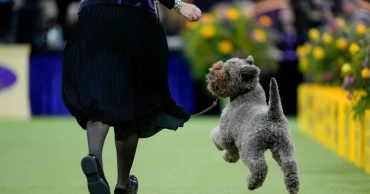
7 dogs competing for Westminster's show big prize
After two days of competition featuring about 2,500 dogs from more than 200 breeds, the Westminster Kennel Club Dog Show has narrowed the field to just seven finalists competing for the most prestigious prize in U.S. dog shows.
The winner will take home a trophy, ribbons and bragging rights, along with the distinction of being crowned best in show at the landmark 150th annual Westminster event.
Among the finalists are Zaida the Afghan hound, JJ the Lhasa apso, Cookie the Maltese and Graham the Old English sheepdog. Also still in contention are Cota, a Chesapeake Bay retriever, and Penny, a Doberman pinscher. One final competitor was due to be selected Tuesday night before all seven meet at Madison Square Garden for the best in show title.
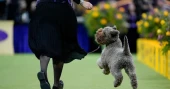
While only a handful advance to the final round, many dogs captured the crowd’s attention during the semifinals with memorable and lighthearted moments. Spectators cheered enthusiastically for Calaco, a hairless Xoloitzcuintli that moved confidently around the ring, while Beamer the vizsla amused fans by hopping into a box meant for his handler’s tools.
Why ‘exercise snacking’ could be an easy alternative to the gym
Storm the Newfoundland drew laughter by leaping up on his handler, nearly matching her height, and cheers for Oliver the golden retriever were so loud they drowned out the arena announcer. Chants also echoed for Lumpy the Pekingese as he strutted before a judge.
One standout semifinalist was Millie, a Danish-Swedish farmdog that made history by competing at Westminster for the first time after the breed became eligible this year. Millie outperformed about 10 other farmdogs to reach the evening round.
“It’s been a very exciting journey” to establish the breed in the United States, said Brita Lemmon of Seal Beach, California, who competed with her own farmdog, Coyote. Lemmon said she first discovered the breed in an encyclopedia and imported her first dog from Denmark in 2000.
Although Westminster titles often go to dogs handled by seasoned professionals or owners with generations of experience, simply qualifying for the champions-only show is a major achievement. That is especially true for newcomers such as Joseph Carrero and his Neapolitan mastiff, Dezi.
Carrero, a heavy equipment operator from Indian Springs, Nevada, said he had wanted a Neapolitan mastiff since his teens and finally got one at age 35. He began showing the dog at the breeder’s request and now both breeds and handles his dogs himself while working full time. “It’s really hard for us to do this, but we enjoy it, and he enjoys it,” he said as visitors gathered to meet the 190-pound mastiff.
Short bursts of daily activity can significantly boost health
Another first-time competitor was Natalee Ridenhour of Royse City, Texas, who entered the show with a Boerboel named Invictus. The powerful South African breed played a major role in her personal life, including how she met her late husband and her move from city life to a farm.
Invictus did not advance past the opening round, but Ridenhour said the experience was still a victory. As visitors eagerly petted the dog, she remarked, “Honestly, the big win is: You’re about the 50th person who’s gotten down in his face and loved on him.”
17 days ago

Horse therapy brings joy and support to children with disabilities in Taiwan
The young woman breaks into a broad smile as she gets ready to mount the horse for her weekly ride. She laughs as the animal takes its first steps.
“She was happy the first time she rode a horse,” Hector Chen said, recalling their initial visit. His daughter, Chen You-ching, was diagnosed with cerebral palsy more than 16 years ago. He has since been bringing the now 18 year old to horse therapy sessions.
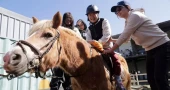
At the Therapeutic Riding Center of Taiwan in Taoyuan, a city in the island’s north, children with cerebral palsy, autism, ADHD and other conditions receive companionship and therapy by riding and interacting with horses.
Animal-assisted therapy is becoming increasingly popular worldwide, whether for children with intellectual disabilities or veterans coping with trauma.
Abigail Liu said her five year old daughter has benefited greatly from the therapy. Her daughter, Ayah, has Angelman syndrome, a rare genetic disorder that causes developmental delays.
She said her daughter “has become less afraid of unfamiliar things and is more willing to try new things. All of this began after she started riding horses here.”
Read More: ‘Paush Sankranti’ horse race keeps rural tradition alive in Narail
The horses require special training to handle a child’s movements and to remain calm when surrounded by several people, said Chan Shu-ya, a horse therapist.
At times, children simply want to hug a horse for an extended period or listen to its heartbeat, and the animals will stand quietly with them.
“They feel very relaxed, because the horse doesn’t show irritation even if they keep talking to it,” said Alain Chang, a horse riding coach at the Fang Hsing-Chung Social Welfare Foundation for Horses in Education and Health. “For them to come here to touch, observe or even hug the horses is a very special experience.”
“Many of the students I work with look forward to coming here every week, rain or shine,” he said.
20 days ago
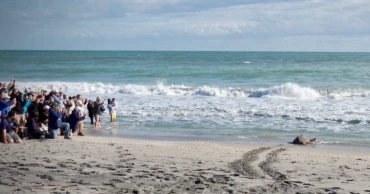
Three-flippered sea turtle Pyari released in Florida, now tracked by satellite
A loggerhead sea turtle with only three flippers swam back into the Atlantic Ocean on Thursday after months of rehabilitation in Florida, drawing cheers from a bundled-up crowd and now carrying a satellite tracker to monitor her movements.
The turtle, named Pyari—a Hindi word meaning “beloved”—had been recovering at the Loggerhead Marinelife Center in Juno Beach following a likely shark attack. The predator left her with severe injuries to her neck, shell, and front flippers, resulting in the amputation of most of her left forelimb.
Japan's last pair of pandas have arrived back in China
To prepare Pyari for her release, staff maintained her tank water at around 80 F (27 C) to help her acclimate. Beachgoers captured photos as she made her way down the sand, the long antenna of her satellite tracker waving behind her, before disappearing into the waves.
Heather Barron, chief science officer and veterinarian at the Marinelife Center, noted that while the beach air was chilly, ranging in the 40s Fahrenheit (4–9 C), the Atlantic remained at a comfortable 77 F (25 C), ideal for her return.
Pyari arrived at the center in November from the nearby Inwater Research Group, where staff began her care after the injuries left her in critical condition. The satellite tracker will now allow scientists to study how she adapts to swimming and surviving in the wild with just three flippers.
22 days ago
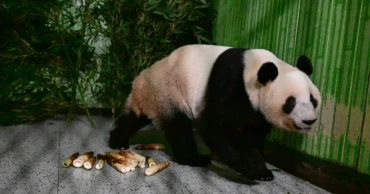
Japan's last pair of pandas have arrived back in China
Japan’s last pair of giant pandas have returned to China, ending the country’s 50-year tradition of hosting the beloved animals.
The twin pandas, Xiao Xiao and Lei Lei, are leaving amid strained diplomatic relations between Japan and China over the new Japanese Prime Minister’s stance on Taiwan, making it unlikely that replacement pandas will be sent to Japan.
Thousands of fans had gathered at Tokyo’s Ueno Zoo to bid farewell to the pandas, who were born there in 2021. China first sent pandas to Japan in 1972 to mark the normalization of diplomatic ties. Over the years, Beijing has used pandas as a diplomatic tool, symbolizing goodwill and soft power, which can be withdrawn when relations sour.
Pet dog guards owner’s body for 4 days amid freezing snowfall
State broadcaster CCTV showed the pandas arriving in crates in Sichuan province, southwestern China. They are now under quarantine at the China Conservation and Research Center for the Giant Panda, which confirmed their safe arrival early Wednesday morning.
Although pandas are often lent to other countries, China retains ownership of the animals, including any offspring.
24 days ago