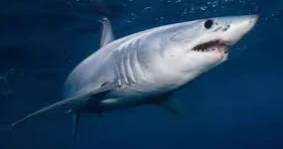
Scientists have captured the first-ever footage of a shark swimming in the icy waters of the Antarctic Ocean, challenging long-held assumptions that sharks do not inhabit the region.
The shark — identified as a sleeper shark — was recorded in January 2025 by a camera operated by the Minderoo-UWA Deep-Sea Research Centre. The device had been deployed off the South Shetland Islands near the Antarctic Peninsula. Researchers had not expected to encounter sharks at such southern latitudes.
Alan Jamieson, founding director of the research centre at the University of Western Australia, said many experts believed sharks were absent from Antarctic waters. “There’s a general assumption that you don’t find sharks in Antarctica,” he said, noting that the specimen was sizeable — estimated at 3 to 4 meters (10 to 13 feet) long. “It’s not small. These animals are like tanks,” he added.
The shark was filmed at a depth of 490 meters (1,608 feet), where the water temperature was just 1.27 degrees Celsius (34.29 degrees Fahrenheit). A skate — a close relative of sharks — was also visible resting on the seabed, though its presence was not unusual as skates are known to inhabit such southern waters.
Jamieson said he could find no prior record of a shark documented within the Antarctic Ocean, also known as the Southern Ocean, which lies south of the 60-degree latitude line. Conservation biologist Peter Kyne of Charles Darwin University, who was not involved in the research, agreed that sharks had never before been recorded so far south.
While climate change and rising ocean temperatures could potentially influence shark distribution, Kyne noted that limited data from the remote Antarctic region makes it difficult to confirm shifts in range. He suggested sleeper sharks may have long existed there undetected.
Researchers believe the shark maintained a depth of around 500 meters because it represented the warmest layer within a stratified water column. Antarctic waters are heavily layered to depths of roughly 1,000 meters due to differences in temperature and density, with colder, denser water below mixing poorly with fresher meltwater near the surface.
Jamieson said the Antarctic sleeper shark population is likely sparse and hard to observe. He suspects others may inhabit similar depths, feeding on the carcasses of whales, giant squid and other marine animals that sink to the ocean floor.
Research cameras at such depths are rare in Antarctic waters and can only operate during the Southern Hemisphere’s summer months from December to February. For the rest of the year, little observation occurs.
“That’s why we still encounter surprises like this,” Jamieson said, describing the footage as a significant discovery.