EU Mission
Hopeful mood, positive electoral climate in Bangladesh: EU chief observer
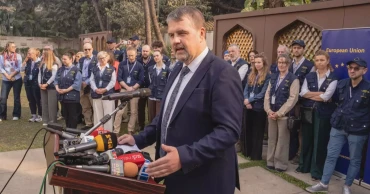
Highlighting the importance of a participatory nature of election, Chief Observer of the European Union Election Observation Mission (EU EOM) to Bangladesh Ivars Ijabs on Tuesday said the general atmosphere and expectations are very hopeful with a positive electoral environment in place.
"We have emphasised the participatory nature of the electoral process which is very much desirable," he told reporters, stressing the importance of inclusion of all communities, minorities and also participation of women in the electoral process.
He said most of their interlocutors have emphasised that there should be a new page in the history of Bangladesh and its democracy. "I would say the electoral environment is very positive. The general atmosphere is very hopeful," Ijabs said.
He, however, said there are many issues that they have discussed and reiterated that they remain neutral without getting involved in any political process. "We are here not to comment on Bangladesh’s politics. We are here to check and observe the process."
In terms of the security situation, the chief observer said their overall perception is that the situation is still under control of the authorities.
They deployed 90 short-term observers (STOs) to observe the election day proceedings in all 64 administrative districts of the country.
The short-term observers will observe opening of polling centres, voting, closing, as well as counting of the ballots and the tabulation of results.
“The short-term observers will be present in cities, towns and villages in almost every constituency. Their observations and reports throughout the day will be a critical element of our impartial and fact-based assessment of these historic elections,” Ijabs told reporters.
With a total of 200 observers deployed across the country, he said they are contributing to the transparency of these historic elections.
"This large and dedicated mission attests to the European Union’s unwavering commitment to the democratic governance of Bangladesh,” said the chief observer.
The deployment of short-term observers builds on the work of 56 long-term observers, who have been in Bangladesh since mid-January, observing the pre-election environment, including preparations by the election administration, campaign activities, voter education efforts, and who have engaged with electoral stakeholders across the political and civil society spectrum.
A delegation of Members of the European Parliament is further reinforcing the mission, and 35 locally recruited short-term observers from the diplomatic missions of the EU Member States, as well as Canada, Norway and Switzerland are also joining the mission.
At full strength, the EU EOM will comprise more than 200 observers, drawn from all 27 EU member states, as well as Canada, Norway and Switzerland.
The EU EOM will present its preliminary findings in a statement at a press conference, on February 14, in Dhaka.
Security, voter participation, level playing field: EU's 3 areas of focus in election
A final report, including recommendations for future electoral processes, will be presented to the authorities after the completion of the entire electoral process. Both documents will be public and will be made available on the Mission’s website.
The EU EOM is bound by a code of conduct, which requires strict neutrality and non-interference.
It undertakes its work in accordance with the Declaration of Principles for International Election Observation, endorsed under UN auspices in 2005.
11 days ago

EU Mission in Dhaka launches publication capturing protests, aspirations for a ‘New Bangladesh’
The European Union Mission in Dhaka launched a publication titled “Bangladesh, 36 July 2024” with reproduction of street paintings and graffiti, capturing the horrors of repression during the July-August protests and the public aspirations of a new Bangladesh.
On the occasion of International Human Rights Day, the publication and a photo exhibition were launched at a ceremony at the EU residence in the capital’s Gulshan area.
Addressing the function, EU Ambassador Michael Miller said respecting, protecting and fulfilling human rights, promoting democracy and upholding the rule of law are at the very core of the European Union. “All our work and all our policies are underpinned by these elements,” he said.
“Human rights are not abstract. They are tangible. They structure how we live together. How we as citizens interact with the state. They protect our dignity and ensure that no one is left behind. They are the foundation of peace, stability and sustainable development. They apply always and everywhere, including in times of conflict or crisis,” said the EU ambassador.
Noting that 2024 has been a watershed moment for Bangladesh, he said Human Rights Day here has special significance for the 1500 people who died and for many thousands more who were injured in the recent movement and for a country in transition.
About the publication, Miller said the artworks reproduced in the EU publication includes the defining moments of the protests that launched the political transition which began on August 5 or “July 36”.
“Our book has been designed to capture a sense of the blazing canvas that is Dhaka, and which marks the horror of repression and the hope of a country now in transition—tragedy, pride. It is an insistence on justice and accountability. This is what you see each and every day going to work, school or the market. It is very impressive for an outsider to see,” he said.
Though the murals were created at a particular moment in time and in a particular place, they address universal issues—freedom of expression, freedom of assembly, non-discrimination, the prohibition of torture, the right to life and the rule of law, said the EU envoy.
Principal Coordinator for SDGs at Chief Adviser's office Lamiya Morshed said the sacrifices made by countless men and women during the July-August uprising are reminders of the enduring struggle for justice and freedom.
“It is our collective duty to honour their legacy by upholding the principles of equality, fairness and being respectful for all individuals,” she said.
Taspia Akter Papie, a student of North South University, said the horrors of July-August forced her to join in painting street art.
“I was not bothered about the quota system, injustice and politics before the July-August uprising. But when I witnessed so many students being killed and many more being injured during the movement, I engaged in painting and graffiti on the streets first in Uttara before August 5 and then in the Bashundhara residential area,” she said.
Another young artist Sayed Maisha Farzana, who lives in Mohammadpur, said she painted some 200 graffiti on streets from Dhaka University campus to Banani area since late July 2024.
French Ambassador Marie Masdupuy, German Ambassador Achim Tröster, Italian Ambassador Antonio Alessandro, Chargé d'Affaires at the Switzerland Embassy Corinne Henchoz Pignani, Executive Director at Manusher Jonno Foundation Shaheen Anam, Barrister Sara Hossain and internationally renowned photographer Shahidul Alam, among others, were present.
1 year ago