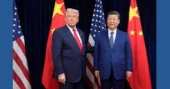
Trump’s tariffs
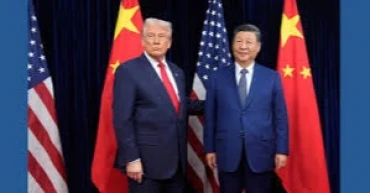
Supreme Court ruling against Trump’s tariffs adds uncertainty to US-China trade relations
The U.S. Supreme Court’s decision to strike down President Donald Trump’s sweeping tariffs has introduced new complexity into U.S.-China relations, which were already fraught with tension. Both nations are maneuvering to avoid a full-blown trade war that could destabilize the global economy, while still competing for leverage in negotiations.
Although the ruling appears to strengthen China’s position, analysts predict Beijing will approach this advantage cautiously, recognizing that Trump has other methods for imposing tariffs. Both sides are also keen to preserve a fragile trade truce and stabilize relations ahead of Trump’s planned trip to Beijing.
“This ruling will boost China’s negotiating position with Trump’s team before the summit, but they are prepared for the scenario where no substantial changes occur,” said Sun Yun, director of the China program at the Stimson Center in Washington.
Trump, frustrated by the ruling, announced plans to impose a temporary 10% global tariff, later increasing it to 15%, while exploring alternative routes to impose import duties. He justified the tariffs by highlighting China as the biggest challenge to U.S. economic, technological, and military dominance.
“China amassed hundreds of billions of dollars in surpluses with the U.S. They rebuilt China, including its military, with our help,” Trump told reporters on Friday. “I have a strong relationship with President Xi, but he now respects our country.”
The White House confirmed Trump’s visit to China is scheduled for March 31 to April 2, where he will meet with President Xi Jinping.
Xi to Focus on Relationship, Not Court Ruling
Xi is unlikely to aggressively highlight the Supreme Court decision when meeting with Trump, opting instead to build a stronger personal rapport with the U.S. president, said Ali Wyne, senior advisor at the International Crisis Group.
"The more Xi can strengthen this relationship, the more likely it is that the fragile trade truce between the U.S. and China will hold, and Trump may be more open to security concessions that offer China greater flexibility in Asia,” Wyne said.
The Chinese Embassy's spokesperson Liu Pengyu commented that trade wars are not in the interest of either country and called for collaboration between Washington and Beijing to ensure stability in economic and trade relations, benefiting both nations and the global economy.
New Uncertainty for Other U.S. Trade Partners
The Supreme Court ruling has also introduced uncertainty for other U.S. trade partners, particularly in Asia, many of whom had reached trade deals to ease the turmoil caused by Trump’s tariffs.
“I expect most Asian countries to proceed cautiously, with existing agreements remaining in place as both sides assess the situation in the coming weeks,” said Dan Kritenbrink, a former U.S. State Department official.
He noted that Japan, a key U.S. ally, is especially important to watch ahead of Prime Minister Sanae Takaichi’s planned visit to Washington in March, as Japan’s relationship with China has worsened in recent months.
Trump’s Alternatives for Tariffs
After returning to the White House early last year, Trump used emergency powers to impose 20% tariffs on Chinese goods, citing Beijing’s failure to curb the flow of chemicals used in fentanyl production. He later expanded this authority to impose reciprocal tariffs on multiple countries, including a 34% levy on China. In response, China retaliated, and tariffs soared into the triple digits before both sides backed down.
Following multiple rounds of trade negotiations and a summit between Trump and Xi in South Korea in October, the two countries agreed to a one-year truce with a 10% baseline tariff. Trump also lowered the fentanyl tariff to 10%, while China resumed efforts to restrict the export of certain substances used in opioid production.
Wendy Cutler, vice president of the Asia Society Policy Institute, suggested the Trump administration could quickly implement a backup plan. The U.S. Trade Representative is investigating China’s adherence to a previous trade agreement, and if China is found to be non-compliant, tariffs could be imposed under U.S. trade law.
Rep. Ro Khanna, the leading Democrat on the House Select Committee on the Chinese Communist Party, urged the administration to adopt a tougher strategy that "holds China accountable for its unfair trade practices and leverages the power of our allies."
Trump’s Flexibility with Tariffs
Gabriel Wildau, managing director at Teneo consultancy, said Trump has already demonstrated his willingness to use various legal authorities to impose tariffs on China, much as he did during his first term. Beijing likely believes the tariffs can be maintained or reintroduced with minimal difficulty.
However, Wildau added, “Beijing hopes they can persuade Trump to reduce the tariffs in exchange for guarantees or other concessions.”
2 hours ago
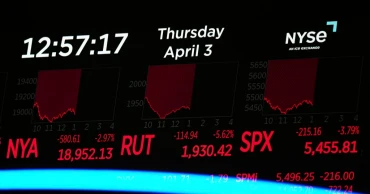
Stock Market endures worst week since 2020 as China retaliates against Trump’s Tariffs
Financial markets experienced their steepest decline since the COVID-19 crash after China retaliated against President Donald Trump’s latest tariff hikes, intensifying the ongoing trade war.
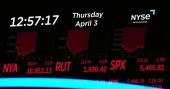
On Friday, the S&P 500 sank 6%, the Dow Jones dropped 5.5%, and the Nasdaq tumbled 5.8%. A surprisingly strong U.S. jobs report couldn’t halt the market downturn.
Meanwhile, President Trump announced he would sign an executive order granting TikTok an additional 75 days to operate in the U.S., allowing time for a potential sale to American investors.
Senate Braces for ‘Vote-a-Rama’ Marathon on GOP Budget Plan
The Senate is gearing up for an all-night session of back-to-back amendment votes—known as "vote-a-rama"—as lawmakers debate the GOP’s sweeping budget plan featuring tax cuts and spending reductions. Democrats are expected to introduce amendments to counter key Republican policies, including proposals to end tariffs, eliminate billionaire tax breaks, and protect Medicaid. These measures are unlikely to pass, as Republicans control Congress and are moving the bill forward to the House.
Naval Academy Purges DEI Books from Library
The U.S. Naval Academy has removed 391 books—including works on the Holocaust, civil rights, feminism, and Maya Angelou’s autobiography—from its library, following an order from Defense Secretary Pete Hegseth to eliminate materials promoting diversity, equity, and inclusion (DEI). The move is part of the Trump administration’s broader push to scrub DEI-related content from federal institutions.
Late-Night Senate Session Begins Amid Tariff Fallout
With pizzas for Republicans and tacos for Democrats, senators are settling in for an overnight session to finalize the GOP’s budget package. Despite growing economic concerns over Trump’s tariffs, Republicans are eager to advance what they view as a cornerstone of their domestic agenda. Democrats plan to prolong debate and draw attention to controversial details.
Columbia Must Notify Students Before Releasing Records in Antisemitism Probe
A federal judge ruled that Columbia University must give students, including activist Mahmoud Khalil, a 30-day notice before turning over documents to a congressional investigation into antisemitism on campuses. The court declined to block the release entirely but allowed students to continue legal challenges. Rep. Tim Walberg, who chairs the investigating committee, called the decision a win for oversight.
Medicare Will Not Cover Popular Anti-Obesity Drugs
The Trump administration has opted not to expand Medicare coverage to include costly anti-obesity medications like Zepbound and Wegovy. While President Biden had proposed a rule to include such treatments, it wasn’t finalized before Trump’s return to office. Medicare will still cover the drugs for patients with heart disease needing risk reduction.
Interior Secretary Orders National Parks to Stay Open Despite Staff Cuts
Interior Secretary Doug Burgum directed national parks to remain open and accessible amid ongoing staffing reductions. A review of operating hours and services has been ordered to ensure visitor access. However, critics question how parks will maintain safety and cleanliness, with roughly 1,500 permanent staff already lost this year and more layoffs looming.
U.S. Announces Additional Aid for Myanmar Earthquake Victims
After criticism over a slow response, the Trump administration has pledged another $7 million in aid for victims of Myanmar’s recent 7.7 magnitude earthquake, bringing total U.S. support to $9 million. While other countries sent large relief teams, the U.S. has deployed only a three-person assessment group. The administration’s dismantling of key aid programs has limited its ability to respond.
Stock Market Suffers Massive Losses Amid Trade Tensions
The S&P 500 fell 6%, marking its worst week since 2020. The Dow dropped 5.5%, and the Nasdaq slid 5.8%. The sell-off came after China imposed tariffs in response to Trump’s latest escalation in the trade war.
TikTok Deal Collapses Following Trump’s Tariff Move
A planned deal to spin off TikTok into a U.S.-based company with majority American ownership fell apart after Trump announced new tariffs. ByteDance reportedly told the White House that China would no longer approve the transaction unless trade negotiations resumed.
10 months ago
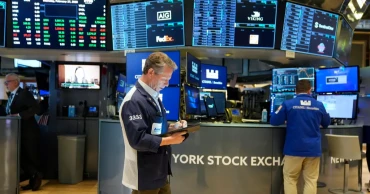
Asian stocks drop as Wall St falls on Trump’s tariffs
Asian markets declined on Tuesday after a sharp drop in U.S. stocks, driven by concerns over the economic impact of President Donald Trump’s latest round of tariffs, reports AP.
A 25% tariff on imports from Canada and Mexico took effect early Tuesday, while an additional 10% tariff was imposed on Chinese goods. In response, Beijing signalled through state media that it was considering retaliatory measures, potentially targeting U.S. agricultural exports such as soybeans.
Women Entrepreneurs organize 3-day trade fair at Gulshan Shooting Club
Japan’s Nikkei 225 fell 1.9% to 37,084.83, while Hong Kong’s Hang Seng index dropped 1.6% to 22,666.68. China’s Shanghai Composite slipped 0.2% to 3,310.35. In South Korea, the Kospi saw a slight gain of less than 0.1% to 2,533.77, while Taiwan’s Taiex declined 0.9%. Most Southeast Asian markets also registered losses.
On Monday, the S&P 500 fell 1.8% to 5,849.72 after Trump declared there was “no room left” for negotiations to lower the tariffs, which he had previously delayed for further discussions. The Dow Jones Industrial Average declined 1.5% to 43,191.24, while the Nasdaq composite dropped 2.6% to 18,350.19.
Wall Street had hoped for a less severe trade stance, and Trump’s decision came amid growing concerns about the U.S. economy. Monday’s losses trimmed the S&P 500’s post-Election Day gains to just over 1%, down from a peak of more than 6%, as the initial optimism surrounding Trump’s economic policies faded.
After the S&P 500 reached a record high last month, driven by stronger-than-expected corporate earnings, sentiment turned negative following weaker economic reports. Recent data showed declining consumer confidence in the face of inflation concerns linked to tariffs.
Another economic report on Monday revealed that while U.S. manufacturing activity continued to expand, it did so at a slower pace than expected. More worryingly, new orders contracted while prices rose, sparking concerns over who would bear the costs of Trump’s tariffs.
Kroger Chairman and CEO resigns following investigation into personal conduct
Following the report, the yield on the 10-year Treasury note fell to 4.16% from 4.24%, continuing its decline from January’s high of nearly 4.80%, reflecting fears of an economic slowdown.
Tech stocks, particularly Nvidia and other high-growth companies, bore the brunt of the market downturn. Nvidia plunged 8.8%, while Tesla lost 2.8%.
Elsewhere, grocery giant Kroger fell 3% after CEO Rodney McMullen resigned following an internal investigation into his personal conduct.
Cryptocurrency-linked stocks also retreated despite an initial rally spurred by Trump’s announcement over the weekend about a strategic crypto reserve. MicroStrategy, which has been investing heavily in bitcoin, ended 1.8% lower, while Coinbase dropped 4.6%.
In Europe, markets surged on Monday following a report indicating a slowdown in inflation for February, boosting expectations of an interest rate cut from the European Central Bank later in the week. Germany’s DAX climbed 2.6%, and France’s CAC 40 rose 1.1%. Despite Trump’s “America First” stance, international markets have outperformed the S&P 500 this year.
In early Tuesday trading, U.S. benchmark crude oil declined 30 cents to $68.07 per barrel, while Brent crude dropped 51 cents to $71.11 per barrel.
The U.S. dollar weakened to 149.29 Japanese yen from 149.50 yen, while the euro edged down to $1.0484 from $1.0488.
Bitcoin tumbled 10.3% to $83,750, according to CoinDesk.
11 months ago