USA-Iran
Trump-Iran tensions expose US policy dilemma
Rising tensions between the United States and Iran have highlighted deep contradictions in President Donald Trump’s foreign policy, as he calls for peace while simultaneously threatening military action against Tehran.
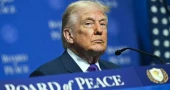
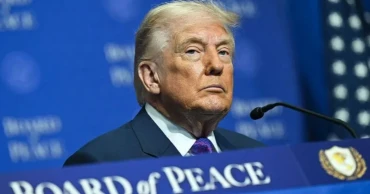
Speaking at a meeting of the Board of Peace, a Middle East coalition he helped form, Trump issued his latest warning to Iran, underscoring the clash between diplomacy and force that has defined much of his second term. While he has said he prefers a negotiated deal to halt Iran’s nuclear weapons programme, the White House has also sharply increased pressure, both rhetorically and militarily.
US officials say Iran would be “very wise” to reach an agreement, but at the same time Washington has overseen what analysts describe as the largest US military buildup in the Middle East since the 2003 Iraq War. Warships, fighter jets and other assets have been deployed near Iran, fuelling fears of a major escalation.
Trump’s threats are being taken seriously, particularly after the US followed through on military action against Venezuela earlier this year, an operation that ended with the capture of former President Nicolás Maduro. Unlike that strike, however, Washington’s objectives in Iran remain unclear.
The US president insists that last year’s strike on Iran “obliterated” its nuclear facilities, but has not explained why further military action may now be necessary, what new targets would be hit, or what the broader political goal would be.
Iran, weakened by sanctions and internal protests against its leadership under Supreme Leader Ayatollah Ali Khamenei, has signalled openness to talks on uranium enrichment. But negotiations have stalled, largely over US demands that Tehran also limit its ballistic missile programme and support for regional proxy groups.
Key questions remain unanswered, including whether Washington seeks regime change in Iran, how it would respond to Iranian retaliation against US bases in the region, and how a prolonged conflict could affect other Middle East priorities, such as efforts to rebuild Gaza under the Board of Peace framework.
Israel’s role is also uncertain. Israel previously joined US strikes on Iran and is widely expected to be involved again if a new campaign begins. Israeli Prime Minister Benjamin Netanyahu discussed the situation with Trump during a recent White House meeting.
Domestically, Trump faces growing political pressure. He returned to office promising to pull the US out of foreign conflicts, a message popular with his support base. Yet since taking office, he has authorised military actions in Syria, Venezuela, Iran and the Caribbean.
A large-scale air campaign against Iran could alienate some supporters ahead of the US midterm elections, particularly as voters express frustration over issues such as immigration and the economy. It could also clash with Trump’s repeated claims that he deserves the Nobel Peace Prize for ending multiple wars, a claim widely disputed.
Despite the uncertainty, Trump appears comfortable keeping allies and adversaries guessing. He has embraced the image of a global dealmaker, hosting high-profile summits and presiding over negotiations on trade, security and diplomacy.
On Iran, however, he has offered only a warning.
“We have to make a meaningful deal,” Trump said. “Otherwise, bad things happen.”
With inputs from BBC
1 day ago
US signals willingness to renew talks with Iran and avoid prolonged war
The Trump administration on Sunday signalled a willingness to renew talks with Iran and avoid a prolonged war in the aftermath of a surprise attack on three of the country’s nuclear sites as US officials assessed Tehran's nuclear ambitions and the threat of retaliation against American interests.
President Donald Trump, who had addressed the nation from the White House on Saturday night, allowed his national security team to speak for him the next morning, staying quiet on social media and scheduling no public appearances.
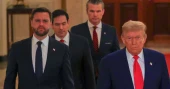
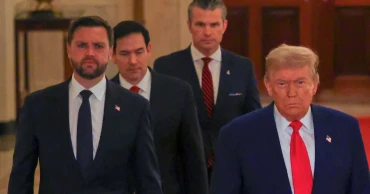
According to AP, the coordinated messaging by his vice president, Pentagon chief, top military adviser and secretary of state suggested a confidence that any fallout from the attack would be manageable and that Iran’s lack of military capabilities would ultimately force it back to the bargaining table.
Defense Secretary Pete Hegseth said at a news conference that America “does not seek war” with Iran while Vice President JD Vance said the strikes have given Tehran the possibility of returning to negotiate with Washington.
“Operation Midnight Hammer, involved decoys and deception, and met with no Iranian resistance, according to Hegseth and Air Force Gen. Dan Caine, chairman of the Joint Chiefs of Staff.
“This mission was not and has not been about regime change,” Hegseth added. Caine said the goal of the operation — destroying nuclear sites in Fordo, Natanz and Isfahan — had been achieved.
“Final battle damage will take some time, but initial battle damage assessments indicate that all three sites sustained extremely severe damage and destruction,” Caine said.
Vance said in a television interview that while he would not discuss “sensitive intelligence about what we’ve seen on the ground,” he felt “very confident that we’ve substantially delayed their development of a nuclear weapon.”
Iranian parliament votes to close Strait of Hormuz following US strikes
Pressed further, he told NBC's “Meet the Press” that “I think that we have really pushed their program back by a very long time. I think that it’s going to be many many years before the Iranians are able to develop a nuclear weapon.”
The vice president said the U.S. had “negotiated aggressively’ with Iran to try to find a peaceful settlement and that Trump made his decision after assessing the Iranians were not acting “in good faith.”
"I actually think it provides an opportunity to reset this relationship, reset these negotiations and get us in a place where Iran can decide not to be a threat to its neighbors, not to a threat to the United States and if they’re willing to do that, the United States is all ears,” Vance said.
Secretary of State Marco Rubio said on CBS's “Face the Nation” that "there are no planned military operations right now against Iran, unless, unless they mess around and they attack" US interests.
Trump has previously threatened other countries, but often backed down or failed to follow through, given his promises to his coalition of voters not to entangle the United States in an extended war.
It was not immediately clear whether Iran saw the avoidance of a wider conflict as in its best interests.
Much of the world is absorbing the consequences of the strikes and the risk that they could lead to more fighting across the Middle East after the US inserted itself into the war between Israel and Iran.
Airstrikes starting on June 12 by Israel that targeted Iran's nuclear facilities and generals prompted retaliation from Iran, creating a series of events that contributed to the US attack.
7 months ago
Trump and US administration used power for massacre in Gaza: Ayatollah Khamenei
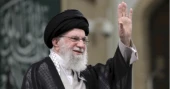
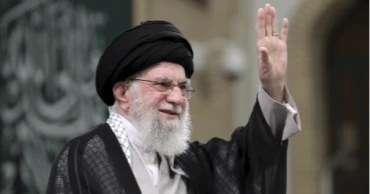
In his first reaction to Trump’s regional visit, Iran’s Supreme Leader Ayatollah Ali Khamenei said Trump wasn't truthful when he made claims about creating peace through power.
“Trump said that he wanted to use power for peace, he lied. He and the US administration used power for massacre in Gaza, for waging wars in any place they could,” Khamenei said Saturday during a meeting with teachers broadcast on state television, reports AP.
The US has provided Israel with 10-ton bombs to “drop on Gaza children, hospitals, houses of people in Lebanon and anywhere else when they can," Khamenei said.
Khamenei, who has the final say on all Iranian state matters, reiterated his traditional stance against Israel.
Israeli strikes kill 93 people in Gaza as Trump wraps up Middle East visit
“Definitely, the Zionist regime is the spot of corruption, war, rifts. The Zionist regime that is lethal, dangerous, cancerous tumor should be certainly eradicated, and it will be," he said, adding that the US has imposed a pattern on Arab nations under which they cannot endeavour without US support.
“Surely this model has failed. With efforts of the regional nations, the US should leave the region, and it will leave," Khamenei said.
Meanwhile, regional leaders were to meet in Baghdad on Saturday at the annual summit of the Arab League, with the war in Gaza expected to once again loom large.
9 months ago
Trump urges Iran toward ‘better path’ in Saudi speech, eyes new nuclear deal
President Donald Trump in a speech in Saudi Arabia urged Iran to take a “new and a better path” as he pushes for a new nuclear deal.
Trump said at the US-Saudi investment conference, during a four-day Middle East trip, that he wants to avoid conflict with Tehran, AP reports.
“As I have shown repeatedly, I am willing to end past conflicts and forge new partnerships for a better and more stable world, even if our differences may be profound,” Trump said.
The comments came as Trump kick off the Mideast trip on Tuesday with his visit to Saudi capital. The latest entreaty to Tehran comes days after Trump dispatched his special envoy Steve Witkoff to meet with Iranian officials for a fourth round of talks aimed at persuading Iran to abandon its nuclear program.
“As President of the United States, my preference will always be for peace and partnership, whenever those outcomes can be achieved,” Trump said.
He also said he hopes Saudi Arabia will soon join the Abraham Accords and recognize Israel “in your own time.”
Trump to meet Syria’s Al-Sharaa, weighs lifting sanctions
Saudi Arabia long has maintained that recognition of Israel is tied to the establishment of a Palestinian state along the lines of Israel’s 1967 borders. Under the Biden administration, there was a push for Saudi Arabia to recognize Israel as part of a major diplomatic deal.
However, the October 7, 2023, Hamas attack on Israel upended those plans and sent the region into one of the worst period of faces it has faced.
In a separate development, the White House announced that Trump will meet Wednesday in Saudi Arabia with Syrian President Ahmad al-Sharaa, the onetime insurgent who last year led the overthrow of former leader Bashar Assad.
The U.S. has been weighing how to handle al-Sharaa since he took power in December. Gulf leaders, have rallied behind the new government in Damascus and will want Trump to follow, believing it is a bulwark against Iran’s return to influence in Syria, where it had helped prop up Assad’s government during a decade-long civil war.
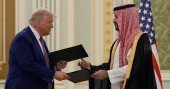
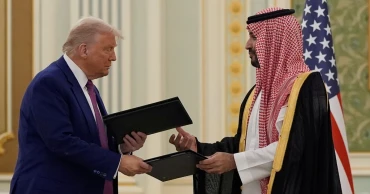
Trump also signed a host of economic and bilateral cooperation agreements with Saudi Arabia on Tuesday to kicked off a four-day Middle East trip with a focus on dealmaking with a key Mideast ally.
Crown Prince Mohammed bin Salman, the Saudi de facto ruler, warmly greeted Trump as he stepped off Air Force One at King Khalid International Airport. The two leaders then retreated to a grand hall at the Riyadh airport, where Trump and his aides were served traditional Arabic coffee by waiting attendants wearing ceremonial gun belts.
“I really believe we like each other a lot,” Trump said later during a brief appearance with the crown prince at the start of a bilateral meeting.
9 months ago