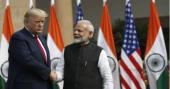
Indian Prime Minister Narendra Modi
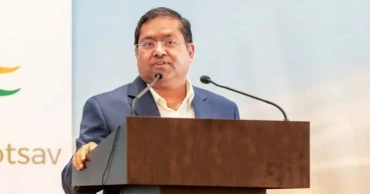
Looking forward to engaging with new govt in Bangladesh: Indian MEA
India on Friday said they look forward to engaging with the new government in Bangladesh and taking things forward, noting that they want to strengthen multifaceted relations with Bangladesh.
"We look forward to engaging with the new government in Bangladesh," Indian Ministry of External Affairs spokesperson Randhir Jaiswal told reporters at a regular briefing in New Delhi.
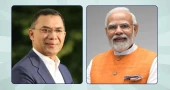
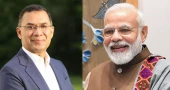
He said the recent letter to Bangladesh Prime Minister Tarique Rahman from his Indian counterpart Narendra Modi underlines India’s commitment to support a 'democratic, progressive and inclusive' Bangladesh.
The Indian Prime Minister congratulated Bangladesh Prime Minister Tarique Rahman soon after his election victory.
Speaker of Lok Sabha Om Birla attended the swearing-in ceremony on February 17, and handed over a letter from the Indian Prime Minister to PM Tarique) Rahman.
“Building on the warm and historic ties between the two countries, India looks forward to further strengthening our multifaceted bilateral ties with Bangladesh," said the MEA Spokesperson while responding to a question.
Jaiswal also spoke about Bangladesh-India visa operations, saying New Delhi would discuss all the aspects of the relations will be discussed.
Inviting Prime Minister Tarique Rahman and his family to visit India, Indian Prime Minister Narendra Modi said Bangladesh and India can truly become catalysts for each other's sustainable growth, work for each other's security and enable mutual prosperity as two fast-growing economies and aspiring societies.
Bangladesh should pursue ‘no-exclusive-alignment’ policy with major powers: Expert
“I look forward to working closely with you to strengthen our multifaceted bilateral relations, enhance regional cooperation, and advance our common goals in wide-ranging areas of connectivity, trade, technology, education, skill development, energy, healthcare, as well as cultural and people-to-people exchanges,” he said in a letter that was handed over to Prime Minister Tarique on Tuesday.
Speaker of the Indian Lok Sabha Om Birla represented the government of India at the swearing-in ceremony of the newly elected government of Bangladesh led by Tarique Rahman, Chairman of Bangladesh Nationalist Party (BNP).
As two close neighbours, Prime Minister Modi said Bangladesh and India have a deep-rooted friendship founded on shared history, cultural ties, and the aspirations of their peoples for peace and prosperity.
“The strong convergence between our respective developmental priorities shall serve as a guiding principle for our future cooperation,” Modi said.
He invited the Prime Minister, his wife Dr Zubaida Rahman, their daughter Barrister Zaima Rahman to pay a visit to India at a convenient time.
“I take this opportunity to invite you, along with Dr Zubaida Rahman and your daughter Zaima, on a visit to India at a mutually convenient time. A warm welcome awaits you in India,” Modi said.
22 hours ago
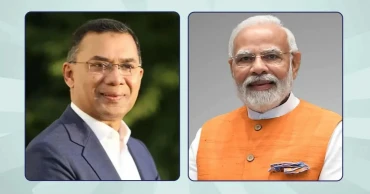
Dhaka, Delhi can work for each other's security, prosperity: Modi tells Tarique
Inviting Prime Minister Tarique Rahman and his family to visit India, Indian Prime Minister Narendra Modi has said Bangladesh and India can truly become catalysts for each other's sustainable growth, work for each other's security and enable mutual prosperity as two fast-growing economies and aspiring societies.
“I look forward to working closely with you to strengthen our multifaceted bilateral relations, enhance regional cooperation, and advance our common goals in wide-ranging areas of connectivity, trade, technology, education, skill development, energy, healthcare, as well as cultural and people-to-people exchanges,” he said in a letter that was handed over to Prime Minister Tarique on Tuesday.
Tarique Rahman: From London exile to Bangladesh’s Prime Minister
Speaker of the Indian Lok Sabha Om Birla represented the government of India at the swearing-in ceremony of the newly elected government of Bangladesh led by Tarique Rahman, Chairman of Bangladesh Nationalist Party (BNP).
Indian Foreign Secretary Vikram Misri accompanied the Speaker.
4 days ago
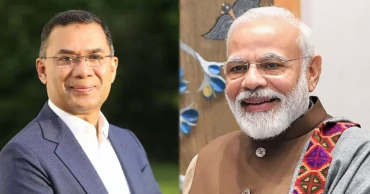
Delhi welcomes Dhaka’s transition to elected govt under Tarique’s leadership
Speaker of the Indian Lok Sabha Om Birla will represent the government of India at the swearing-in ceremony of the newly elected government of Bangladesh led by Tarique Rahman, Chairman of Bangladesh Nationalist Party (BNP), on February 17.
The Speaker’s participation in this ‘important event’ underscores the deep and enduring friendship between the peoples of Bangladesh and India, reaffirming India's steadfast commitment to the democratic values that bind the two nations, said the Indian Ministry of External Affairs (MEA) on Sunday.
Although it was not mentioned in the MEA’s statement, Indian Foreign Secretary Vikram Misri will accompany the Speaker, a diplomatic source in New Delhi told UNB.
Modi talks to Tarique over phone, reaffirms India's support
As neighbours united by a shared history, culture, and mutual respect, India welcomed Bangladesh's transition to an elected government under the leadership of Tarique Rahman, whose vision and values have received an overwhelming mandate of the people, the MEA said in a statement.
Earlier, Chief Adviser Prof Muhammad Yunus invited Indian Prime Minister Narendra Modi to attend the swearing-in ceremony as BNP is set to form the government with a landslide victory against an alliance led by Jamaat-NCP.
"Yes, we have received the invitation from Prof Yunus," a diplomatic source from New Delhi told UNB on Sunday morning.
Meanwhile, he said, the India AI Imact Summit will take place in New Delhi from the 16th to the 20th of this month.
About 20 heads of State, including President Macron, will be hosted by India around the same time, another source from Delhi told UNB, indicating that Prime Minister Modi is unable to come but will send his representative.
The India-AI Impact Summit 2026 will mark a historic milestone in global cooperation on Artificial Intelligence. It will be the first global AI summit to be hosted in the Global South.
The Indian Prime Minister was one of the global leaders who congratulated BNP first. He spoke with the BNP chief over the phone and extended support in his endeavour to fulfill the aspirations of the people of Bangladesh.
Indian parliament pays tributes to Bangladesh’s former PM Khaleda Zia
"Delighted to speak with Tarique Rahman. I congratulated him on the remarkable victory in the Bangladesh elections," PM Modi said.
He conveyed his best wishes and support in his endeavour to fulfill the aspirations of the people of Bangladesh.
"As two close neighbours with deep-rooted historical and cultural ties, I reaffirmed India’s continued commitment to the peace, progress, and prosperity of both our peoples," said the Indian Prime Minister.
In a separate message through his X handle, PM Modi conveyed his warm congratulations to Tarique Rahman on leading BNP to a decisive victory in the Parliamentary elections in Bangladesh.
"This victory shows the trust of the people of Bangladesh in your leadership," PM Modi said.
India will continue to stand in support of a democratic, progressive and inclusive Bangladesh, he said.
"I look forward to working with you to strengthen our multifaceted relations and advance our common development goals," PM Modi said.
Indian Parliament to pay homage today to Khaleda Zia
The new cabinet members of Bangladesh’s incoming government will be sworn in at 4pm on Tuesday at the South Plaza of Parliament, with President Mohammed Shahabuddin administering the oath.
Leaders of other South Asian countries have also been invited. On the other hand, Chinese Ambassador to Bangladesh Yao Wen will represent China at the swearing-in ceremony.
6 days ago
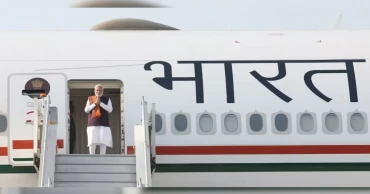
Modi begins Malaysia visit, spotlight on growing strategic ties
Indian Prime Minister Narendra Modi on Saturday began a two-day official visit to Malaysia, a trip seen as significant for further strengthening bilateral relations that were elevated to a Comprehensive Strategic Partnership in August 2024.
This is Modi’s third visit to Malaysia and his first since the two countries upgraded ties during Malaysian Prime Minister Anwar Ibrahim’s state visit to India last year. The Indian prime minister is scheduled to hold bilateral talks with Anwar, focusing on political, economic and defence cooperation.
India and Malaysia formally established diplomatic relations in 1957, with ties steadily expanding over the decades. Relations were upgraded to an Enhanced Strategic Partnership during Modi’s 2015 visit, before being elevated further last year.
Political engagement between the two sides has remained consistent in recent years, with frequent leader-level interactions on multilateral platforms. Modi and Anwar met on the sidelines of the BRICS Summit in Brazil in July 2025, while Modi also attended the ASEAN-India Summit virtually from Kuala Lumpur in October 2025. The two leaders have also held regular telephone and virtual discussions.
High-level ministerial exchanges have continued, including visits by India’s External Affairs Minister S Jaishankar and Defence Minister Rajnath Singh. Defence cooperation has expanded, with India increasing its institutional presence in Malaysia, including the opening of a Hindustan Aeronautics Limited regional office in Kuala Lumpur in 2023.
Economic ties have also deepened, with bilateral trade reaching nearly $19.85 billion in the 2024-25 financial year. Malaysia is India’s third-largest trading partner within ASEAN, while India ranks among Malaysia’s top 10 global trading partners.
People-to-people links remain a key pillar of the relationship. Malaysia hosts around 2.9 million people of Indian origin, one of the largest Indian diaspora communities worldwide. Cultural and educational cooperation has grown through initiatives such as academic chairs supported by India at Malaysian universities.
During the visit, Modi is expected to interact with members of the Indian diaspora and business leaders. Discussions may also explore avenues for enhanced defence collaboration, including aircraft sales and maintenance support, according to India’s Ministry of External Affairs.
With inputs from NDTV
14 days ago
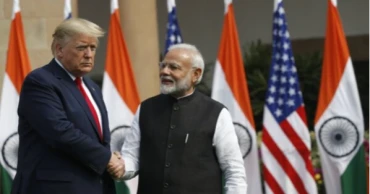
Trump calls PM Modi the "nicest human being"
Former U.S. President and Republican candidate Donald Trump recently expressed admiration for Indian Prime Minister Narendra Modi, describing him as a "friend" and "one of the nicest human beings."
During a conversation on the Flagrant podcast, Trump remarked on his impression of global leaders, highlighting Modi's leadership in India, according to India Today magazine.
He said, "Modi is a friend and one of the nicest people I've met. Before he became Prime Minister, India was quite unstable. On the outside, he appears fatherly, but he's also a strong, decisive leader."
1 year ago

Mamata Banerjee displeased over exclusion from Dhaka-Delhi water sharing talks
West Bengal Chief Minister Mamata Banerjee has expressed her dissatisfaction with Indian Prime Minister Narendra Modi for excluding her from the recent water-sharing discussions with Bangladesh Prime Minister Sheikh Hasina during their meeting in New Delhi.
In a strongly worded letter to Modi, dated June 24, 2024, she wrote: “I am writing this letter in context of the recent visit of Hon'ble Prime Minister of Bangladesh. It seems that water sharing issues relating to the Ganges and Teesta rivers may have been discussed during the meeting. Such unilateral deliberations and discussions without consultation and the opinion of the state government is neither acceptable nor desirable.”
Dhaka, Delhi discussed joint river management: Hasan Mahmud
Mamata emphasized the importance of West Bengal's relationship with Bangladesh, stating, “We do share a very close relationship with Bangladesh - geographically, culturally and economically, I love and respect people of Bangladesh and always wish for their well-being. The state of West Bengal has cooperated with Bangladesh on several issues in the past.”
She highlighted several successful collaborations, including the exchange of India-Bangladesh enclaves (Chitmahal), the Indo-Bangladesh Railway Line, and Bus Services. However, she underlined the critical importance of water resources, saying, “Water is very precious and is the lifeline of the people. We cannot compromise on such a sensitive issue which has severe and adverse implication on the people. People of West Bengal will be the worst sufferers due to the impact of such agreements.”
Peaceful management of border a shared priority: Dhaka, Delhi
The West Bengal Chief Minister raised concerns about the renewal of the Indo-Bangladesh Farakka Treaty, set to expire in 2026. She noted, “It is a Treaty which delineates the principles of sharing of water between Bangladesh and India and as you are aware it has huge implications for the people of West Bengal for maintaining their livelihood and that the water which is diverted at the Farakka Barrage helps in maintaining the navigability of the Kolkata port.”
She pointed out the changes in river morphology in eastern India and Bangladesh, which have negatively impacted water availability in West Bengal. “There has been eastward migration of the Ganges (and Padma in Bangladesh) over the last 200 years disrupting their link with several rivers in West Bengal. For example, Jalangi and Mathabhanga rivers got disconnected from Padma and the fresh water inflow into the Sundarban has reduced. In fact, the genesis of construction of Farakka Barrage Project is the disconnection of Bhagirathi from the Ganges.”
Hasina, Modi endorse shared vision for future enhancing connectivity, commerce, collaboration for shared prosperity
Mamata expressed frustration over the lack of response to her previous communications on these issues, stating, “On these issues, I have written several times to draw your attention.”
Regarding the Teesta river, she wrote, “Further, it seems that sharing of Teesta water between India and Bangladesh has also been discussed in the meeting. The health of Teesta river has suffered from construction of series of hydropower projects in Sikkim, deforestation in upper catchment and impact of climate change.”
She criticized the Indian government’s proposal for bilateral cooperation to restore the Teesta in Bangladesh, noting the lack of concrete steps taken by the Ministry of Jal Shakti to restore the river onthe Indian side. “I am surprised by the fact that no concrete steps have been taken by the Ministry of Jal Shakti to restore the river in its original form and health on the Indian side. Due to reasons stated above water flow in the Teesta has gone down over the years and it is estimated that, if any water is shared with Bangladesh, lakhs of people in North Bengal (West Bengal) will get severely impacted due to inadequate availability of irrigation water.”
In her concluding remarks, Mamata reiterated her strong reservations, “Finally, it is to convey my strong reservation that no discussion on sharing of Teesta water and the Farakka Treaty should be taken up with Bangladesh without the involvement of the state government. The interest of people in West Bengal is paramount which should not be compromised at any cost.”
Flood-hit people in Sylhet face food, drinking water crisis though water receding
1 year ago

India announces steps to implement a citizenship law that excludes Muslims
Prime Minister Narendra Modi's government on Monday (March 11, 2024) announced rules to implement a 2019 citizenship law that excludes Muslims, weeks before the Hindu nationalist leader seeks a third term in office.
The Citizenship Amendment Act provides a fast track to naturalization for Hindus, Parsis, Sikhs, Buddhists, Jains and Christians who fled to Hindu-majority India from Afghanistan, Bangladesh and Pakistan before Dec. 31, 2014. The law excludes Muslims, who are a majority in all three nations.
The law was approved by Indian Parliament in 2019, but Modi’s government had held off with its implementation after deadly protests broke out in capital New Delhi and elsewhere. Scores were killed during days of clashes.
The nationwide protests in 2019 drew people of all faiths who said the law undermines India’s foundation as a secular nation. Muslims were particularly worried that the government could use the law, combined with a proposed national register of citizens, to marginalize them.
The National Register of Citizens is part of Modi government’s effort to identify and weed out people it claims came to India illegally. The register has only been implemented in the northeastern state of Assam, and the ruling Bharatiya Janata Party has promised to roll out a similar citizenship verification program nationwide.
19 dead and 7 missing as landslide and flash floods hit Indonesia's Sumatra island
Modi’s government has defended the 2019 citizenship law as a humanitarian gesture. It argues that the law is meant only to extend citizenship to religious minorities fleeing persecution and would not be used against Indian citizens.
“These rules will now enable minorities persecuted on religious grounds in Pakistan, Bangladesh and Afghanistan to acquire citizenship in our nation,” Home Minister Amit Shah wrote on X, formerly Twitter.
India’s main opposition Congress party questioned the announcement, saying “the timing right before the elections is evidently designed to polarise the elections.”
Human rights watchdog Amnesty India in a statement called the law “discriminatory” and said it “goes against the constitutional values of equality and international human rights law.” It said the law “legitimises discrimination based on religion” and is “exclusionary in its structure and intent.”
India is home to 200 million Muslims who make up a large minority group in the country of more than 1.4 billion people. They are scattered across almost every part of India and have been targeted in a series of attacks that have taken place Modi first assumed power in 2014.
Critics say Modi’s conspicuous silence over anti-Muslim violence has emboldened some of his most extreme supporters and enabled more hate speech against Muslims.
Modi has increasingly mixed religion with politics in a formula that has resonated deeply with India’s majority Hindu population. In January, he opened a Hindu temple at the site of a demolished mosque in northern Ayodhya city, fulfilling his party’s long-held Hindu nationalist pledge.
North Korea threatens to take military moves in response to US-South Korean drills
Most poll surveys suggest Modi will win a majority in a general election that is scheduled to be held by May.
1 year ago
Modi urges G20 foreign ministers to overcome differences
Indian Prime Minister Narendra Modi has urged G20 foreign ministers to overcome their differences and to reach consensus on issues of deep concern to poorer countries.
In a video address to the assembled foreign ministers in New Delhi, Indian Prime Minister Narendra Modi urged them not to allow current tensions to destroy agreements that might be reached on food and energy security, climate change and the debt crisis.
“We are meeting at a time of deep global divisions,” Modi told the group, which included U.S. Secretary of State Antony Blinken, Chinese Foreign Minister Qin Gang and their Russian counterpart Sergey Lavrov, whose discussions would naturally be “affected by the geopolitical tensions of the day.”
“We all have our positions and our perspectives on how these tensions should be resolved,” he said, adding that: “We should not allow issues that we cannot resolve together to come in the way of those we can.”
Top diplomats from the world’s major industrialized and developing nations on Thursday opened what are expected to be contentious talks dominated by Russia’s war in Ukraine and China’s moves to boost its global influence.
In a nod to fears that the increasingly bitter rift between the United States and its allies on one side and Russia and China on the other appears likely to widen further, Modi said that “multilateralism is in crisis today.”
He lamented that the two main goals of the post-World War II international order — preventing conflict and fostering cooperation — were elusive. “The experience of the last two years, financial crisis, pandemic, terrorism and wars clearly shows that global governance has failed in both its mandates,” he said.
Indian Foreign Minister S. Jaishankar then addressed the group in person, telling them that they “must find common ground and provide direction.”
While they were all in the same room, there was no sign that Blinken would sit down with either his Russian or Chinese counterparts. Ahead of the meeting, Blinken said he had no plans to meet with them individually but expected to see them in group settings.
In addition to attending the G-20 and seeing Modi and Jaishankar individually on Thursday, Blinken’s official schedule had him meeting only the foreign ministers of Brazil, Indonesia, the Netherlands, Mexico, Nigeria and South Africa.
2 years ago

PM likely to attend G20 Summit in New Delhi September
Prime Minister Sheikh Hasina is likely to attend the 18th G20 Summit which will take place in New Delhi on September 9-10 this year.
Indian Prime Minister Narendra Modi has invited her Bangladesh counterpart Sheikh Hasina to attend the Summit.
India, which holds the Presidency of the G20 from 1 December 2022 to 30 November 2023, has invited Bangladesh as a “guest country” in its all meetings, spokesperson at the Ministry of Foreign Affairs Seheli Sabrin told reports at a weekly briefing on Thursday.
Bangladesh sees its series of engagements with the Group of Twenty (G20) under India’s Presidency this year as a “big honour” for the country.
“We will raise our issues there. It is a big honour for us. We should be prudent,” Foreign Minister Dr AK Abdul Momen told reporters at the Ministry of Foreign Affairs recently, noting that Bangladesh is the only South Asian country invited by the host.
The Group of Twenty (G20) is the premier forum for international economic cooperation, which plays an “important role” in shaping and strengthening global architecture and governance on all major international economic issues.
India has invited Bangladesh, Egypt, Mauritius, the Netherlands, Nigeria, Oman, Singapore, Spain and the United Arab Emirates (UAE) as guest countries to its meetings and summit, according to the Ministry of External Affairs, India.
Apart from the G20 leaders, Egyptian President Abdel Fattah Saeed Hussein Khalil El-Sisi, Mauritian Prime Minister Pravind Kumar Jugnauth, Dutch Prime Minister Mark Rutte, Nigerian President Muhammadu Buhari, Oman Head of State Sultan Haitham bin Tarik, Singapore Prime Minister Lee Hsien Loong, Spanish Prime Minister Pedro Sánchez, UAE President Sheikh Mohamed bin Zayed Al Nahyan have been invited to the G20 Summit.
Meanwhile, Momen will attend the G20 foreign ministers' meeting in New Delhi on March 1-2.
Hasina paid a state visit to India from September 5 to 8 last year at the invitation of her Indian counterpart Narendra Modi.
Read more: Being invited to G20 Summit is a big honour for Bangladesh, says Momen
Ahead of the Prime Minister and Foreign Minister’s visits, Vinay Kwatra will be in Dhaka in the third week of February to have bilateral talks with his Bangladesh counterpart Masud Bin Momen, said a diplomatic source.
Kwatra assumed charge as foreign secretary on May 1 last year.
The Group of Twenty (G20) comprises 19 countries - Argentina, Australia, Brazil, Canada, China, France, Germany, India, Indonesia, Italy, Japan, Republic of Korea, Mexico, Russia, Saudi Arabia, South Africa, Türkiye, United Kingdom and United States and the European Union.
The G20 members represent around 85% of the global GDP, over 75% of the global trade, and about two-thirds of the world population.
3 years ago

Hasina asks Indian and Bangladeshi youth to interact more to foster friendship
Prime Minister Sheikh Hasina today (September 7, 2022) asked the youth of Bangladesh and India to interact more closely and work in close collaboration like their leaders did in the past.
“We feel, youths of both the countries need to interact more closely and connect to the shared history because they are the future leaders and leaders across the borders must work in close collaboration, like our leaders did in the past,” she said.
The prime minister was addressing a function marking the distribution of Mujib Scholarship awards among the direct descendants of soldiers or officers of defence forces of India who had been martyred or critically wounded during the Liberation War of Bangladesh in 1971.
Indian External Affairs Minister Dr S. Jaishankar and Bangladesh Liberation War Affairs Minister AKM Mozammel Huq, also spoke at the function held at the Ball room of ITC Maurya hotel here in New Delhi.
Bangladesh has introduced the scholarship in honour of the country’s founding leader Bangabandhu Sheikh Mujibur Rahman.
Hasina, now on a four-day official visit to India, said she would really love to see that the descendants of the war heroes act as ambassadors of Bangladesh-India friendship and draw parallels with their great forefathers.
“I would like to conclude by praying to the Almighty to bless the new generation so that they may carry the torch of friendship forward for the next 50 years and beyond,” she said.
The prime minister said the event is especially very close to her heart as this is an opportunity for paying sincere homage to all the martyrs - both from Bangladesh and India, who laid down their lives during our Liberation War in 1971 and to the war veterans of both the countries.
“I am truly delighted to reconnect with you – the descendant family members of our war heroes,” she said.
She mentioned that the Bangalee nation under the leadership of Father of the Nation Bangabandhu Sheikh Mujibur Rahman waged struggle for economic, cultural and democratic emancipation for 24 years.
Read:Dhaka, Delhi reiterate strong commitment to eliminate terrorism
“Responding to the clarion call of our great leader Bangabandhu Sheikh Mujib, they fought for the liberation of the country in 1971. We witnessed an unparalleled gesture of friendship from the government and people of India, as we were provided with empathy, shelter and resources,” she said.
Sheikh Hasina, on behalf of the people of Bangladesh, expressed gratitude to the Indians who sacrificed their invaluable lives and shed blood for the cause of the war of liberation.
“It is always an honour for us to remember those noble persons who sacrificed their lives. My salutations to you, to the brave hearts ---our heroes!” she went on.
She said Bangladesh government commenced a programme to honour the foreign friends who contributed to the Liberation War in 1971.
“We were fortunate to be able to hold the first ceremony of award in 2011 when the highest Civilian Award to foreign friends ‘Bangladesh Freedom Award’ was conferred on the former Indian Prime Minister Smt. Indira Gandhi," said the Bangladesh premier.
Subsequently, more awards were conferred on the deserving Indian leaders, including former Indian Prime Minister Atal Bihari Vajpayee and former President Pranab Mukherjee, she said.
“War heroes and members of civil society of India were also honoured in a phased manner. A total of 340 foreign nationals and organizations were honoured. Among them, 226 were from India alone,” she said.
In April 2017, she had the great honour to confer awards upon the war veterans of India through their descendants and immediate family members in the presence of Indian PM Narendra Modi in New Delhi, said Sheikh Hasina.
“I would like to appreciate the kind gesture of government of India for extending their support to our Freedom Fighters for their treatment in India as well as offering scholarship to the family members of the Freedom fighters.”
She said it certainly demonstrates India’s continued support and goodwill for the war heroes of Bangladesh who fought for the emergence of an independent and sovereign Bangladesh.
The prime minister said that conferment of 200 Mujib Scholarships, 100 each at Class-X and Class-X II level, to the descendants of Indian war veterans is a token of our homage to the heroes who made supreme sacrifice in 1971 for our cause.
“As we aspire to carry forward the legacies of our great forefathers from generation to generation, this is our humble effort to reconnect the younger generations to the historic past of which they are a proud part.”
Read:Hasina, Modi direct officials to start CEPA negotiations this year
She mentioned that the awardees of the scholarship would have an opportunity to revisit the memories of valour of their forefathers, relate it to the present circumstances and would continue to bridge between the two countries.
The relationship between Bangladesh and India goes far beyond strategic partnership and has further strengthened during the last decade, she continued.
“Having forged a strong partnership over the last 50 years, both countries are working on an increasingly wide range of sectoral collaboration.”
In this regard, Hasina said resolution of longstanding issues of demarcation of maritime and land boundaries bear testimony to that effect.
“The relationship is known to be the ‘Role Model for the Neighbourhood Diplomacy’ worldwide.”
She said Bangladesh and India are passing through a path of friendship and 2021 was a landmark year in our relations.
She said in March last year said that she had the opportunity to welcome Modi in Dhaka in the historic celebrations of the Birth Centenary of the Father of the Nation Bangabandhu Sheikh Mujibur Rahman, Golden Jubilee of Bangladesh’s independence and 50th anniversary of the establishment of Bangladesh and India diplomatic relations. The president of India also joined the glorious celebration of the 50th anniversary of Bangladesh’s victory in the War of Liberation in December 2021.
To celebrate these occasions, she said, a number of joint programmes were held. Among them, the release of commemorative stamps on Bangabandhu and Mahatma Gandhi and Bangladesh-India friendship; Bangabandhu-Bapu Digital Exhibition; participation of Bangladesh Contingent in the Republic Day parade of India were noteworthy.
Sheikh Hasina said that Joint production of the biopic on Bangabandhu Sheikh Mujibur Rahman titled ‘Mujib: the Making of the Nation’ is underway, and is expected to be released soon.
She said Bangladesh and India have jointly celebrated December 6 as ‘Maitree Diwas’, the day being a historic one when India recognised Bangladesh as an independent and sovereign state in 1971, in 20 selected cities, including Dhaka and New Delhi.
“Through this joint celebrations, Bangladesh and India have projected the good neighbourhood which is based on mutual trust and respect, to other countries around the world,” she said.
The Prime Minister said that people of Bangladesh should not forget that India, its government, its people and armed forces stood beside Bangladesh during its Liberation war.
"I want that our friendship will last forever,” she said.
Indian Foreign Minister S Jaishankar thanked Prime Minister Sheikh Hasina for her precious and generous gesture for introducing the scholarship.
He said that the existing good relations between the two neighbouring countries will deepen further in the coming days.
3 years ago