astronauts

Preparing astronauts for Moon missions: challenges of isolation and survival
As NASA’s Artemis programme prepares to return humans to the Moon, astronauts will face extreme isolation, harsh environments, and a range of physical and psychological challenges.
NASA astronaut Victor Glover, set to pilot Artemis II—the first crewed Orion capsule mission beyond the Moon—emphasised the mission's difficulty. “Space is really challenging. It’s harder than it looks,” he said, noting that resources like water and food are finite with no immediate resupply. Even daily routines, including hygiene, could disturb fellow crew members in the confined spacecraft.
Artemis II marks the initial step toward establishing a lunar base near the Moon’s South Pole, where astronauts will live for months, enduring long lunar nights, extreme temperatures, dust, and high radiation levels.
Sergi Vaquer Araujo, head of space medicine at the European Space Agency (ESA), highlighted the need for astronauts who excel across multiple domains. Physical fitness remains crucial, and chronic conditions such as asthma or heart issues can disqualify candidates. Equally important are cognitive and psychological skills, including teamwork, resilience, and the ability to cope with stress in confined, isolated conditions.
British surgeon Nina Purvis, who spent a winter at ESA’s Concordia research station in Antarctica, described the experience as a “White Mars” simulation, highlighting the importance of cooperation, adaptability, and mental health management. Experiments there, including mindfulness exercises, have informed strategies for future space missions.
Meanwhile, architects Sebastian Aristotelis and Karl-Johan Sørensen tested lunar habitat prototypes in northern Greenland, living 60 days in a prefabricated, solar-powered structure to simulate Moon-base conditions. Their experiment focused on practical living, psychological adaptation, and design challenges for future lunar habitats.
Glover, who has trained for years for the Moon mission, acknowledged the uncertainty of leaving Earth behind. “I don’t know if I’m fully prepared psychologically. Ask me that when I get back,” he said.
The Artemis programme represents humanity’s next leap in lunar exploration, combining rigorous astronaut selection, psychological preparation, and innovative habitat design to overcome the unique challenges of life on the Moon.
With inputs from BBC
5 days ago
Life on the Moon will test astronauts beyond physical limits
As Nasa prepares for its Artemis programme to return humans to the Moon, space agencies say future astronauts will face extreme physical, psychological and social challenges far beyond those experienced during earlier space missions.
Nasa astronaut Victor Glover, who will pilot the Artemis II mission, says space travel is far more demanding than many people realise. The mission will take the Orion spacecraft farther than any crewed mission in history, with four astronauts confined to a small capsule for about 10 days without any possibility of resupply.
Glover said even basic resources such as food and water must be carefully managed, while privacy will be almost non existent. Routine activities, including using the hygiene compartment, can disrupt the entire crew due to noise in the tight living space. He said such conditions require extensive psychological preparation, not just technical skill.
Artemis II marks the first stage of humanity’s long term return to the Moon. Future missions plan to land astronauts near the Moon’s South Pole and establish a base where crews may live for months. Astronauts will operate days away from Earth in an airless, dusty environment with extreme temperatures, high radiation levels and lunar nights lasting up to two weeks.
Experts say selecting the right astronauts is crucial. According to Sergi Vaquer Araujo of the European Space Agency, the ideal candidate is not exceptional in just one area but competent across many domains, including physical health, mental resilience and teamwork.
While early astronauts were chosen mainly for peak physical fitness and competitive instincts, modern missions place greater emphasis on cooperation and emotional intelligence. ESA’s recent astronaut selection process focused heavily on group tasks, rewarding candidates who prioritised team success over individual achievement.
Certain medical conditions still disqualify candidates, including chronic lung disease, heart irregularities or colour blindness. Space agencies say this is necessary because advanced medical treatment is not available during deep space missions.
To better understand how people cope with long term isolation, scientists study environments on Earth that resemble space conditions. British surgeon Nina Purvis recently spent a winter at the Concordia research station in Antarctica, living with 12 others in complete isolation for several months. She said adaptability, calmness under pressure and being pleasant to work with are essential traits.
Researchers at Concordia also examined boredom and mental wellbeing, finding that structured group activities such as yoga, art and mindfulness exercises improved morale and social cohesion. Scientists believe similar practices will become part of daily routines for future Moon crews.
Private initiatives are also contributing to lunar living research. During the Covid pandemic, two European architects lived for 60 days in a prototype Moon habitat in northern Greenland. The compact structure was designed to simulate confinement while providing personal space and artificial lighting to maintain healthy sleep cycles.
The experiment later led to a company specialising in designing space habitats for agencies and private firms. One of the designers said living in extreme conditions helped identify small daily frustrations that could be solved through better design.
Despite years of preparation, Glover admits that the psychological impact of travelling so far from Earth remains uncertain. He said the true test of readiness will only come after the mission is complete.
As space agencies move closer to sustained human presence on the Moon, experts agree that success will depend as much on mental strength, cooperation and adaptability as on rockets and technology.
With inputs from BBC
12 days ago
NASA's stranded astronauts greet their replacements at space station
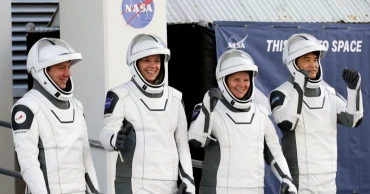
Just over a day after launching, a SpaceX crew capsule arrived at the International Space Station on Sunday, bringing the replacements for NASA’s two stranded astronauts.
The four newcomers — from the U.S., Japan, and Russia — will spend the next few days getting acquainted with the station’s operations from Butch Wilmore and Suni Williams. Afterward, the two will board their own SpaceX capsule later this week to wrap up an unexpectedly extended mission that began last June.
What's Pi Day all about? Math, science, pies and more
Wilmore and Williams had anticipated being gone for only a week when they launched on Boeing’s first astronaut flight, but they marked the nine-month milestone earlier this month.
The Boeing Starliner capsule faced so many issues that NASA insisted it return empty, leaving its test pilots behind to await a SpaceX lift.
Their ride finally arrived in late September, but with a reduced crew of two and two vacant seats reserved for the return journey. Additional delays occurred when their replacements’ brand-new capsule required extensive battery repairs. An older capsule took its place, pushing their return back by a couple of weeks to mid-March.
Saturn’s moon count soars: 128 new moons discovered
Weather permitting, the SpaceX capsule carrying Wilmore, Williams, and two other astronauts will undock from the space station no earlier than Wednesday and splash down off Florida's coast.
11 months ago

SpaceX sends Saudi astronauts, including nation’s 1st woman in space, to International Space Station
Saudi Arabia's first astronauts in decades rocketed toward the International Space Station on a chartered multimillion-dollar flight Sunday.
SpaceX launched the ticket-holding crew, led by a retired NASA astronaut now working for the company that arranged the trip from Kennedy Space Center. Also on board: a U.S. businessman who now owns a sports car racing team.
The four should reach the space station in their capsule Monday morning; they'll spend just over a week there before returning home with a splashdown off the Florida coast.
Sponsored by the Saudi Arabian government, Rayyanah Barnawi, a stem cell researcher, became the first woman from the kingdom to go to space. She was joined by Ali al-Qarni, a fighter pilot with the Royal Saudi Air Force.
Also Read: UAE spacecraft takes close-up photos of Mars' little moon
They're the first from their country to ride a rocket since a Saudi prince launched aboard shuttle Discovery in 1985. In a quirk of timing, they'll be greeted at the station by an astronaut from the United Arab Emirates.
"Hello from outer space! It feels amazing to be viewing Earth from this capsule," Barnawi said after settling into orbit.
Added al-Qarni: "As I look outside into space, I can't help but think this is just the beginning of a great journey for all of us."
Rounding out the visiting crew: Knoxville, Tennessee's John Shoffner, former driver and owner of a sports car racing team that competes in Europe, and chaperone Peggy Whitson, the station's first female commander who holds the U.S. record for most accumulated time in space: 665 days and counting.
Also Read: SpaceX takes second shot at launching biggest rocket
"It was a phenomenal ride," Whitson said after reaching orbit. Her crewmates clapped their hands in joy.
It's the second private flight to the space station organized by Houston-based Axiom Space. The first was last year by three businessmen, with another retired NASA astronaut. The company plans to start adding its own rooms to the station in another few years, eventually removing them to form a stand-alone outpost available for hire.
Axiom won't say how much Shoffner and Saudi Arabia are paying for the planned 10-day mission. The company had previously cited a ticket price of $55 million each.
NASA's latest price list shows per-person, per-day charges of $2,000 for food and up to $1,500 for sleeping bags and other gear. Need to get your stuff to the space station in advance? Figure roughly $10,000 per pound ($20,000 per kilogram), the same fee for trashing it afterward. Need your items back intact? Double the price.
At least the email and video links are free.
The guests will have access to most of the station as they conduct experiments, photograph Earth and chat with schoolchildren back home, demonstrating how kites fly in space when attached to a fan.
After decades of shunning space tourism, NASA now embraces it with two private missions planned a year. The Russian Space Agency has been doing it, off and on, for decades.
"Our job is to expand what we do in low-Earth orbit across the globe," said NASA's space station program manager Joel Montalbano.
SpaceX's first-stage booster landed back at Cape Canaveral eight minutes after liftoff — a special treat for the launch day crowd, which included about 60 Saudis. "It was a very, very exciting day," said Axiom's Matt Ondler.
2 years ago
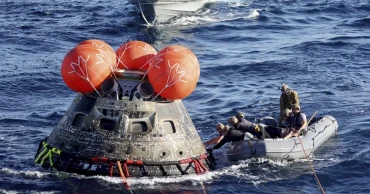
NASA Orion capsule safely blazes back from moon, aces test
NASA’s Orion capsule made a blisteringly fast return from the moon Sunday, parachuting into the Pacific off Mexico to conclude a test flight that should clear the way for astronauts on the next lunar flyby.
The incoming capsule hit the atmosphere at Mach 32, or 32 times the speed of sound, and endured reentry temperatures of 5,000 degrees Fahrenheit (2,760 degrees Celsius) before splashing down west of Baja California near Guadalupe Island. A Navy ship quickly moved in to recover the spacecraft and its silent occupants — three test dummies rigged with vibration sensors and radiation monitors.
NASA hailed the descent and splashdown as close to perfect, as congratulations poured in from Washington..
“I'm overwhelmed,” NASA Administrator Bill Nelson said from Mission Control in Houston. “This is an extraordinary day ... It's historic because we are now going back into space — deep space — with a new generation.”
Read more: NASA's Orion capsule reaches moon, last big step before lunar orbit
The space agency needed a successful splashdown to stay on track for the next Orion flight around the moon, targeted for 2024 with four astronauts who will be revealed early next year. That would be followed by a two-person lunar landing as early as 2025 and, ultimately, a sustainable moon base. The long-term plan would be to launch a Mars expedition by the late 2030s.
Astronauts last landed on the moon 50 years ago. After touching down on Dec. 11, 1972, Apollo 17′s Eugene Cernan and Harrison Schmitt spent three days exploring the valley of Taurus-Littrow, the longest stay of the Apollo era. They were the last of the 12 moonwalkers.
Orion was the first capsule to visit the moon since then, launching on NASA’s new mega moon rocket from Kennedy Space Center on Nov. 16. It was the first flight of NASA’s new Artemis moon program, named after Apollo’s mythological twin sister.
“From Tranquility Base to Taurus-Littrow to the tranquil waters of the Pacific, the latest chapter of NASA’s journey to the moon comes to a close. Orion back on Earth,” announced Mission Control commentator Rob Navias.
While no one was on the $4 billion test flight, NASA managers were thrilled to pull off the dress rehearsal, especially after so many years of flight delays and busted budgets. Fuel leaks and hurricanes conspired for additional postponements in late summer and fall.
In an Apollo throwback, NASA held a splashdown party at Houston’s Johnson Space Center on Sunday, with employees and their families gathering to watch the broadcast of Orion’s homecoming. Next door, the visitor center threw a bash for the public.
Getting Orion back intact after the 25-day flight was NASA’s top objective. With a return speed of 25,000 mph (40,000 kph) — considerably faster than coming in from low-Earth orbit — the capsule used a new, advanced heat shield never tested before in spaceflight. To reduce the gravity or G loads, it dipped into the atmosphere and briefly skipped out, also helping to pinpoint the splashdown area.
Read more: NASA’s newest moon rocket lifts off 50 years after Apollo
All that unfolded in spectacular fashion, officials noted, allowing for Orion’s safe return.
“I don't think any one of us could have imagined a mission this successful," said mission manager Mike Sarafin.
Further inspections will be conducted once Orion is back at Kennedy by month’s end. If the capsule checks find nothing amiss, NASA will announce the first lunar crew amid considerable hoopla in early 2023, picking from among the 42 active U.S. astronauts stationed at Houston’s Johnson Space Center.
“People are anxious, we know that,” Vanessa Wyche, Johnson's director, told reporters. Added Nelson: “The American people, just like (with) the original seven astronauts in the Mercury days, are going to want to know about these astronauts.”
The capsule splashed down more than 300 miles (482 kilometers) south of the original target zone. Forecasts calling for choppy seas and high wind off the Southern California coast prompted NASA to switch the location.
Orion logged 1.4 million miles (2.25 million kilometers) as it zoomed to the moon and then entered a wide, swooping orbit for nearly a week before heading home.
It came within 80 miles (130 kilometers) of the moon twice. At its farthest, the capsule was more than 268,000 miles (430,000 kilometers) from Earth.
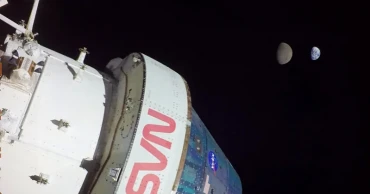
Orion beamed back stunning photos of not only the gray, pitted moon, but also the home planet. As a parting shot, the capsule revealed a crescent Earth — Earthrise — that left the mission team speechless.
Nottingham Trent University astronomer Daniel Brown said the flight's many accomplishments illustrate NASA's capability to put astronauts on the next Artemis moonshot.
“This was the nail-biting end of an amazing and important journey for NASA’s Orion spacecraft," Brown said in a statement from England.
The moon has never been hotter. Just hours earlier Sunday, a spacecraft rocketed toward the moon from Cape Canaveral. The lunar lander belongs to ispace, a Tokyo company intent on developing an economy up there. Two U.S. companies, meanwhile, have lunar landers launching early next year.
3 years ago
.jpg)
SpaceX brings 4 astronauts home with midnight splashdown
SpaceX brought four astronauts home with a midnight splashdown in the Gulf of Mexico on Friday, capping the busiest month yet for Elon Musk’s taxi service.
The three U.S. astronauts and one German in the capsule were bobbing off the Florida coast, near Tampa, less than 24 hours after leaving the International Space Station. NASA expected to have them back in Houston later in the morning.
NASA’s Raja Chari, Tom Marshburn and Kayla Barron, and the European Space Agency’s Matthias Maurer, embraced the seven astronauts remaining at the station, before parting ways.
“It’s the end of a six-month mission, but I think the space dream lives on,” Maurer said.
SpaceX brought up their U.S. and Italian replacements last week, after completing a charter trip to the station for a trio of businessmen.
That amounts to two crew launches and two splashdowns in barely a month. Musk’s company has now launched 26 people into orbit in less than two years, since it started ferrying astronauts for NASA. Eight of those 26 were space tourists.
READ: SpaceX launches 4 astronauts for NASA after private flight
“Welcome home,” SpaceX Mission Control radioed at splashdown. “Thanks for flying SpaceX.”
“That was a great ride,” replied Chari, the capsule commander. As for the reintroduction to gravity, he noted: “Only one complaint. These water bottles are super heavy.”
The newly returned astronauts said their mission was highlighted by the three visitors and their ex-astronaut escort who dropped by in April, opening up NASA’s side of the station to paying guests after decades of resistance.
On the down side, they had to contend with a dangerous spike in space junk after Russia blew up a satellite in a missile test in mid-November. More than 1,500 pieces of shrapnel spread across Earth's orbit for years to come.
While the war in Ukraine has caused tensions between the U.S. and Russia, the astronauts have stood by their Russian crewmates, and vice versa. Flight controllers in Houston and Moscow also continued to cooperate as always, according to NASA officials.
As he relinquished command of the space station earlier this week, Marshburn called it “a place of peace” and said international cooperation would likely be its lasting legacy. Russian Oleg Artemyev, the new commander, also emphasized the “peace between our countries, our friendship” in orbit and described his crewmates as brothers and sisters.
Up there now are three Russians, three Americans and one Italian.
It was Marshburn’s third spaceflight, and the first for the three returning with him. Chari and Barron’s next stop could be the moon; they are among 18 U.S. astronauts picked for NASA’s Artemis moon-landing program. Two others in that elite group are now at the space station.
3 years ago

SpaceX launches 4 astronauts for NASA after private flight
SpaceX launched four astronauts to the International Space Station for NASA on Wednesday, less than two days after completing a flight chartered by millionaires.
It’s the first NASA crew comprised equally of men and women, including the first Black woman making a long-term spaceflight, Jessica Watkins.
“This is one of the most diversified, I think, crews that we’ve had in a really, really long time,” NASA’s space operations mission chief Kathy Lueders said on the eve of launch.
The astronauts were due to arrive at the space station Wednesday night, 16 hours after their predawn liftoff from Kennedy Space Center. They will spend five months at the orbiting lab.
SpaceX has now launched five crews for NASA and two private trips in just under two years. Elon Musk’s company is having an especially busy few weeks: It just finished taking three businessmen to and from the space station as NASA’s first private guests.
Also read: SpaceX’s Elon Musk: 1st orbital Starship flight maybe March
A week after the new crew arrives, the three Americans and German they’re replacing will return to Earth in their own SpaceX capsule. Three Russians also live at the space station.
Both SpaceX and NASA officials stressed they’re taking it one step at a time to ensure safety. The private mission that concluded Monday encountered no major problems, they said, although high wind delayed the splashdown for a week.
SpaceX Launch Control wished the astronauts good luck and Godspeed moments before the Falcon rocket blasted off with the capsule, named Freedom by its crew.
“Our heartfelt thank you to every one of you that made this possible. Now let Falcon roar and Freedom ring,” radioed NASA astronaut Kjell Lindgren, the commander. Minutes later, their recycled booster had landed on an ocean platform and their capsule was safely orbiting Earth. “It was a great ride,” he said.
The SpaceX capsules are fully automated — which opens the space gates to a broader clientele — and they’re designed to accommodate a wider range of body sizes. At the same time, NASA and the European Space Agency have been pushing for more female astronauts.
While two Black women visited the space station during the shuttle era, neither moved in for a lengthy stay. Watkins, a geologist who is on NASA’s short list for a moon-landing mission in the years ahead, sees her mission as “an important milestone, I think, both for the agency and for the country.”
She credits supportive family and mentors — including Mae Jemison, the first Black woman in space in 1992 — for “ultimately being able to live my dream.”
Also cheering Watkins on was another geologist: Apollo 17′s Harrison Schmitt, who walked on the moon in 1972. She invited the retired astronaut to the launch, along with his wife. “We sort of consider ourselves the Jessica team,” he said, chuckling
“Those of us who rode the Saturn V into space are a little bit jaded about the smaller rockets,” Schmitt said after the SpaceX liftoff. “But still, it really was something and on board was a geologist ... I hope it will stand her in good stead for being part of one of the Artemis crews that go to the moon.”
Also read: SpaceX’s Musk: 1st Starship test flight to orbit in January
Like Watkins, NASA astronaut and test pilot Bob Hines is making his first spaceflight. It’s the second visit for the European Space Agency’s lone female astronaut, Samantha Cristoforetti, a former Italian Air Force fighter pilot, and Lindgren, a physician.
The just-completed private flight was NASA’s first dip into space tourism after years of opposition. The space agency said the three people who paid $55 million each to visit the space station blended in while doing experiments and educational outreach. They were accompanied by a former NASA astronaut employed by Houston-based Axiom Space, which arranged the flight.
“The International Space Station is not a vacation spot. It’s not an amusement park. It is an international laboratory, and they absolutely understood and respected that purpose,” said NASA flight director Zeb Scoville.
NASA also hired Boeing to ferry astronauts after retiring the shuttles. The company will take another shot next month at getting an empty crew capsule to the space station, after software and other problems fouled a 2019 test flight and prevented a redo last summer.
3 years ago

Four station astronauts catch ride with SpaceX back home
Four astronauts in orbit since spring headed back to Earth on Monday, aiming for a late night splashdown off the Florida coast.
The undocking of their SpaceX capsule from the International Space Station also paved the way for a launch of their four replacements as early as Wednesday night.
Read:China's 1st woman to spacewalk works 6 hours outside station
The newcomers were scheduled to launch first, but NASA switched the order because of bad weather and an astronaut's undisclosed medical condition. The welcoming duties will now fall to the lone American and two Russians left behind at the space station.
NASA astronauts Shane Kimbrough and Megan McArthur, Japan's Akihiko Hoshide and France's Thomas Pesquet should have been back Monday morning, but high wind in the recovery zone delayed their homecoming. Their splashdown was planned for the Gulf of Mexico off Pensacola.
“One more night with this magical view. Who could complain? I’ll miss our spaceship!” Pesquet tweeted alongside a brief video showing the space station illuminated against the blackness of space and the twinkling city lights on the nighttime side of Earth.
From the space station, NASA astronaut Mark Vande Hei -- midway through a one-year flight -- bid farewell to each of his departing friends, telling McArthur "I’ll miss hearing your laughter in adjacent modules.”
Before leaving the neighborhood, the four took a spin around the space station to take pictures. This was the first time SpaceX attempted a flyaround like this; NASA's shuttles used to do it all the time before their retirement a decade ago.
Read: Russian filmmakers land after shoot aboard space station
It wasn't the most comfortable ride back. The toilet in their capsule was broken, and so the astronauts needed to rely on diapers for the eight-hour trip home. They shrugged it off late last week as just one more challenge in their mission.
The first issue arose shortly after their April liftoff; Mission Control warned a piece of space junk was threatening to collide with their capsule. It turned out to be a false alarm. Then in July, thrusters on a newly arrived Russian lab inadvertently fired and sent the station into a spin. The four astronauts took shelter in their docked SpaceX capsule, ready to make a hasty departure if necessary.
Among the upbeat milestones: four spacewalks to enhance the station's solar power, a movie-making visit by a Russian film crew and the first-ever space harvest of chile peppers. Their 200-day mission began last April.
4 years ago
.jpg)
China launches first three-man crew to new space station
China launched the first three crew members on a mission to its new space station Thursday in its first crewed mission in five years.
The astronauts, already wearing their spacesuits, were seen off by the commander of China’s manned space program, other uniformed military personnel and a crowd of children waving flowers and flags and singing patriotic songs. The three gave final waves to a crowd of people waving flags as the entered the elevator to take them to the spaceship at the Jiuquan launch center in northwestern China.
The astronauts are traveling in the Shenzhou-12 spaceship launched by a Long March-2F Y12 rocket that blasted off shortly after the target time of 9:22 a.m. (0122 GMT) heading into the bright-blue skies with near-perfect visibility at the launch center on the edge of the Gobi Desert.
The two veteran astronauts and a newcomer making his first space flight are heading to the Tianhe, or Heavenly Harmony, station for a three-month stay in its main living compartment where they will carry out experiments, test equipment, conduct maintenance and prepare the station for receiving two additional modules next year.
Also read: Mars mission: China prepares to launch Long March-5 rocket
The rocket dropped its boosters about two minutes into the flight followed by the coiling surrounding Shenzhou-12 at the top of the rocket. After about 10 minutes it separated from the rocket’s upper section and extended its solar panels.
After the Tianhe was launched in April, the rocket that carried it into space made an uncontrolled reentry to Earth, though China dismissed criticism. Usually, discarded rocket stages reenter the atmosphere soon after liftoff, normally over water, and don’t go into orbit.
The rocket used Thursday is of a different type and the components that will reenter are expected to burn up long before they could be a danger, said Ji Qiming, assistant director of the China Manned Space Agency.
Also read: China’s Mars rover touches ground on red planet
The mission brings to 14 the number of Chinese astronauts traveling into space since China launched its first crewed mission in 2003, becoming only the third country after the former Soviet Union and the United States to do so on its own.
The mission is the third of 11 planned through next year to add the additional sections to the station and send up crews and supplies. A fresh three-member crew and a cargo ship with supplies will be sent in three months.
China is not a participant in the International Space Station, largely as a result of U.S. objections to the Chinese programs secrecy and close military ties. However, China has been stepping up cooperation with Russia and a host of other countries, and its station may remain in space beyond the International Space Station, which is reaching the end of its functional life.
Read:China receives photos from Mars: state-run media
The mission builds on experience China gained from earlier operating two experimental space stations. It also landed a probe on Mars last month that carried a rover, the Zhurong, and earlier landed a probe and rover on the moon and brought back the first lunar samples by any country’s space program since the 1970s.
4 years ago

SpaceX capsule departs station with 4 astronauts, heads home
A SpaceX capsule carrying four astronauts departed the International Space Station late Saturday, aiming for a rare nighttime splashdown to end the company’s second crew flight.
It would be the first U.S. splashdown in darkness since Apollo 8′s crew returned from the moon in 1968.
NASA’s Mike Hopkins, Victor Glover and Shannon Walker, and Japan’s Soichi Noguchi, headed home in the same Dragon capsule that delivered them to the space station last November. The ride back was expected to take just 6 1/2 hours.
Read Also: China launches main part of its 1st permanent space station
“Thanks for your hospitality,” Hopkins radioed as the capsule undocked 260 miles (420 kilometers) above Mali.
SpaceX targeted a splashdown around 3 a.m. Sunday in the Gulf of Mexico off the coast of Panama City, Florida. Despite the early hour, the Coast Guard deployed extra patrols — and spotlights — to keep any night-owl sightseers away. The capsule of the first SpaceX crew was surrounded by pleasure boaters last summer, posing a safety risk.
Hopkins, the spacecraft commander, rocketed into orbit with his crew on Nov. 15 from NASA’s Kennedy Space Center. Their replacements arrived a week ago aboard their own Dragon capsule — the same one that launched SpaceX’s first crew last spring.
The four should have been back by now, but high offshore wind kept them at the space station a few extra days. SpaceX and NASA determined the best weather would be before dawn.
The delays allowed Glover to celebrate his 45th birthday in space Friday.
Read Also: Biggest space station crowd in decade after SpaceX arrival
“Gratitude, wonder, connection. I’m full of and motivated by these feelings on my birthday, as my first mission to space comes to an end,” Glover tweeted.
Saturday night’s undocking left seven astronauts at the space station: three Americans, two Russians, one Japanese and one French.
The Associated Press Health and Science Department receives support from the Howard Hughes Medical Institute’s Department of Science Education. The AP is solely responsible for all content.
4 years ago