Parliament
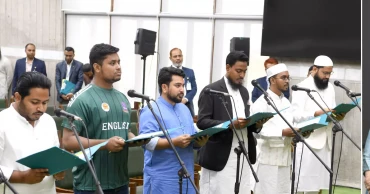
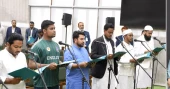
6 NCP MPs-elect sworn in as members of Parliament, CRC
Six MPs-elect of the National Citizen Party (NCP) on Tuesday took oath as members of the Parliament and members of the Constitution Reform Council(CRC).
Chief Election Commissioner (CEC) AMM Nasir Uddin administered the oath of office to the MPs at the Oath Taking Room of Sangsad Bhaban at 1:05 pm.
Earlier, BNP MPs took oath as only members of the 13th parliament, not as members of the Constitution Reform Council on Tuesday morning.
Parliament Secretariat Secretary Kaniz Moula conducted the oath-taking ceremony.
The MPs-elect of Bangladesh Jamaat-e-Islam took oath as members of both the 13th Parliament and the Constitution Reform Council at 12:22 pm.
The 13th parliamentary election and referendum on the July National Charter (Constitutional Reform) Implementation Order 2025 were held on Thursday last (February 12) in 299 out of the country’s 300 constituencies amid festivity and peaceful atmosphere.
On Friday last, the EC published a gazette of 297 elected MP candidates. The election results of two other constituencies – Chattogram-2 and 4-- were withheld as per the court orders.
Besides, the election to Sherpur-3 was earlier cancelled following the death of a contesting candidate.
But, BNP Chairman Tarique Rahman left Bogura-6 seat for by-election, taking oath as a member of parliament from Dhaka-17 constituency.
In the election, Bangladesh Nationalist Party (BNP) secured 209 parliamentary seats, while Bangladesh Jamaat-e-Islami won 68.
Besides, National Citizen Party-NCP settled victory in six constituencies, independent candidates in seven constituencies, Bangladesh Khelafat Majlish in two, Islami Andolan Bangladesh in one, Bangladesh Jatiya Party-BJP (led by Andaleeve Rahman Partho) in one, Ganaodhikar Parishad in one, Ganasamhati Andolan in one and Khelafat Majlish in one parliamentary seat.
So, the BNP-led electoral alliance sealed victory in a total of 212 constituencies, while the Jamaat-led electoral alliance won in 77 constituencies.
4 days ago
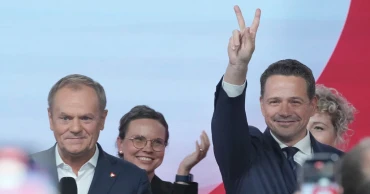
Poland to hold presidential election on May 18: Parliament speaker
The head of Poland's parliament said Wednesday that the country's presidential election will be held on May 18, with a runoff on June 1 if needed.
The election will decide whether the pro-European Union Cabinet of Prime Minister Donald Tusk will gain an ally in the presidential palace at a challenging time for Poland and for Europe, with a full-scale war in neighbouring Ukraine.
The incumbent right-wing President Andrzej Duda is at odds with the government, blocking legislation and making strongly critical comments. In the latest spat, Duda chose skiing over attending a concert gala marking the launch of Poland's rotating presidency in the EU.
Duda is to leave office in August, ending his second five-year term. He cannot seek another term, according to Poland’s constitution.
Szymon Holownia, the powerful speaker of the lower house of parliament, or Sejm, has declared he will run for president as head of Poland 2050, a party within the ruling coalition.
Austrian FM Schallenberg appointed as interim govt leader
He said he was announcing the election date early in the political calendar to allow ample time for procedures and campaigning, which can officially begin from Jan. 15.
The powers of the president are limited in Poland, where the government decides on domestic and international policy. The president is the supreme commander of the armed forces, cooperating with the government. He can propose legislation and veto new laws and also has a say on Poland's foreign relations.
The chief governing party, the Civic Coalition, has chosen Warsaw Mayor Rafal Trzaskowski as its candidate for president. Tusk, the party's leader and former head of the European Union, has chosen to stay in his government seat.
The right-wing opposition party, Law and Justice, backs historian Karol Nawrocki in the election. Nawrocki, now head of a national history institute, IPN, has been a controversial figure. Recent media reports allege Nawrocki had ties to hard-right groups and acquaintances in criminal circles. Nawrocki denies the allegations.
Law and Justice was ousted in the 2023 general election after eight years of turbulent, euro-sceptic rule. Duda hailed from the party and was largely its ally.
A far-right leader, Slawomir Mentzen, is running in the election for the Konfederacja (Confederation) party.
1 year ago
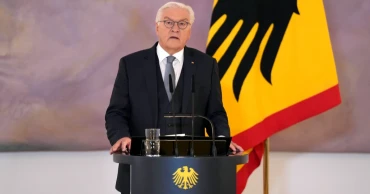
Germany's president dissolves parliament, sets national election for Feb 23
German President Frank-Walter Steinmeier on Friday ordered parliament dissolved and set new elections for Feb. 23 in the wake of the collapse of Chancellor Olaf Scholz's coalition, saying it was the only way to give the country a stable government capable of tackling its problems.
Scholz lost a confidence vote on Dec. 16 and leads a minority government after his unpopular and notoriously rancorous three-party coalition collapsed on Nov. 6 when he fired his finance minister in a dispute over how to revitalize Germany’s stagnant economy.
Steinmeier said he made the decision because it was clear after consultation with party leaders that there was no agreement among Germany's political parties on a majority for a new government in the current parliament.
“It is precisely in difficult times like these that stability requires a government capable of taking action and a reliable majority in parliament,” he said as he made the announcement in Berlin.
"Therefore I am convinced that for the good of our country new elections are the right way.”
China sanctions 7 companies over US military assistance to Taiwan
Since the post-World War II constitution doesn’t allow the Bundestag to dissolve itself, it was up to Steinmeier to decide whether to dissolve parliament and call an election. He had 21 days to make that decision. Once parliament is dissolved, the election must be held within 60 days. Leaders of several major parties agreed earlier on the election date of Feb. 23, seven months earlier than originally planned.
Steinmeier warned about outside interference in the poll, saying it is “a danger to democracy, whether it is covert, as was evidently the case recently in the Romanian elections, or open and blatant, as is currently being practiced particularly intensively on platform X.”
A top Romanian court annulled the first round of the country’s presidential election, days after allegations emerged that Russia ran a coordinated online campaign to promote the far-right outsider who won the first round.
The campaign is already well underway. Polls show Scholz’s party trailing the conservative opposition Union bloc led by Friedrich Merz. Vice Chancellor Robert Habeck of the environmentalist Greens, the remaining partner in Scholz’s government, is also bidding for the top job — though his party is further back. If recent polls hold up, the likely next government would be led by Merz as chancellor in coalition with at least one other party.
Key issues include immigration, how to get the sluggish economy going, and how best to aid Ukraine in its struggle against Russia.
The populist, anti-immigration Alternative for Germany, or AfD, which is polling strongly, has nominated Alice Weidel as its candidate for chancellor but has no chance of taking the job because other parties refuse to work with it.
Germany’s electoral system traditionally produces coalitions, and polls show no party anywhere near an absolute majority on its own. The election is expected to be followed by weeks of negotiations to form a new government.
It’s only the fourth time that the Bundestag has been dissolved ahead of schedule under Germany’s post-World War II constitution. It happened under Chancellor Willy Brandt in 1972, Helmut Kohl in 1982 and Gerhard Schroeder in 2005. Schroeder used the confidence vote to engineer an early election narrowly won by center-right challenger Angela Merkel.
1 year ago
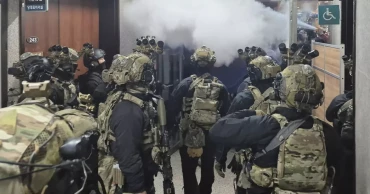
Resignation of South Korean President Yoon demanded over Martial Law
South Korea’s political landscape was shaken on Wednesday as the main opposition Democratic Party called for President Yoon Suk Yeol’s immediate resignation or impeachment. The demand came hours after Yoon rescinded a controversial martial law declaration, which had briefly brought military troops to parliament.
Yoon’s abrupt announcement of martial law on Tuesday evening aimed to combat what he termed “anti-state” forces but was overturned by a unanimous parliamentary vote. This marked South Korea’s first use of martial law in over 40 years, harking back to its pre-democracy era.
Opposition Outrage and Impeachment Threat
The Democratic Party, holding a parliamentary majority, condemned Yoon’s actions as unconstitutional and accused him of rebellion.
“President Yoon Suk Yeol’s martial law declaration was a clear violation of the constitution... a grave act of rebellion,” the party said in a statement, promising impeachment proceedings if Yoon refused to step down.
An impeachment would require a two-thirds parliamentary vote, needing support from at least 200 lawmakers. The Democratic Party and smaller opposition factions collectively control 192 seats. Notably, 18 members of Yoon’s ruling People Power Party (PPP) joined the 190-0 vote to annul the martial law.
If impeached, Yoon would be stripped of presidential powers pending a Constitutional Court ruling, with Prime Minister Han Duck-soo assuming interim responsibilities.
Yoon’s Declaration and Military Deployment
Yoon’s martial law authorized troop deployments to restrict parliamentary activities, sparking comparisons to South Korea’s military-backed governments of the past. Protesters outside the National Assembly faced soldiers armed with assault rifles and military helicopters.
While lawmakers were initially blocked from entering the National Assembly, opposition leader Lee Jae-myung livestreamed himself scaling a wall to access the chamber. Despite the heavy military presence, no major violence was reported, and troops withdrew after the vote to lift the martial law.
Read: South Korean Parliament overturns President’s Martial Law declaration
Critics, including legal experts and opposition leaders, argued Yoon’s actions violated constitutional provisions that limit martial law to wartime or comparable national emergencies. The constitution explicitly prohibits restrictions on parliamentary functions, which Yoon’s declaration attempted to enforce.
International and Domestic Responses
In Washington, the White House expressed “serious concern” over the events, noting that the Biden administration was not informed in advance of Yoon’s martial law declaration. Pentagon officials confirmed no impact on the 27,000 U.S. troops stationed in South Korea.
Domestically, the People Power Party leader Han Dong-hun criticized Yoon’s actions as unconstitutional, urging him to dismiss Defense Minister Kim Yong Hyun, who reportedly recommended the declaration.
Public reaction remained relatively muted, with life in Seoul appearing normal on Wednesday. Tourists and residents went about their routines, though increased police presence and lingering tension hinted at the political turmoil.
Echoes of South Korea’s Democratic Struggles
President Yoon’s martial law declaration and its swift reversal highlighted South Korea’s turbulent political history, including its transition to democracy in the late 1980s. Observers compared the current crisis to the 2017 impeachment of former President Park Geun-hye, who was removed from office and later imprisoned for corruption.
Read: Emergency martial law declared in South Korea
Natalia Slavney, an analyst with the Stimson Center’s 38 North program, described the martial law as a “serious backslide of democracy” in South Korea, noting an “alarming trend of abuse” during Yoon’s presidency.
As calls for Yoon’s resignation grow louder, South Korea faces an uncertain political future. The crisis underscores the fragility of democratic norms in the face of escalating political conflicts.
Source: With inputs from agencies
1 year ago

Govt measures to tame inflation soon: PM tells Parliament
Prime Minister Sheikh Hasina on Wednesday said inflation in Bangladesh will come under control soon due to government’s various initiatives and a better outlook in the developed economies.
“Inflation is expected to come down significantly in 2024 in key economies including the US and the European Union,” she told the parliament in reply to a tabled question from opposition Jatiya Party lawmaker Mujibul Haque Chunnu.
Women now empowered in Bangladesh: PM
She hoped that inflation will go down because of reduction in the prices of fuel, food products and fertilizers in the global market, adjustment of fuel oil prices and government initiatives to normalize the food supply situation.
The prime minister’s comments came during her question-answer session.
She said Bangladesh is experiencing various economic crises due to the adverse impact on the global economy triggered by Russia-Ukraine conflict and war-related sanctions that started soon after Covid-19 pandemic.
Bangladesh and BIMSTEC to work together: PM Hasina
“This has had a significant impact on inflation, subsidy expenditure, balance of trade, foreign exchange reserves and exchange rates,” she said.
In reply to another query from Independent MP (from Dhaka-19) Saiful Islam, the Leader of the House said that the country is feeling the pressure of imported inflation due to the increase in the prices of some products in the world market such as fuel oil, edible oil, wheat, fertilisers, various food products, consumer goods and industrial raw materials.
Focus on rural dev along with infrastructure: PM Hasina tells ECNEC
“The government is currently continuing all kinds of activities to keep the prices of consumer goods normal,” she told the lawmaker.
2 years ago

More than 6,000 abandoned houses are in Dhaka city: Housing Minister
There are more than 6,000 abandoned houses in Dhaka city, said Housing and Public Works Minister RAM Obaidul Muktadir Chowdhury in Parliament on Wednesday.
“There are 6,372 abandoned houses in the capital city,” he said, replying to a question from independent lawmaker Muhammad Saiful Islam (Dhaka-19).
According to data placed by the Minister in the House, the highest 3,582 abandoned houses are in Mirpur, while 1,542 ones in Mohammadpur.
New executive committee of BSFA pays homage to Bangabandhu
Other abandoned houses include 128 ones are in Gulshan, 9 in Banani, 62 in Moghbazar, 36 in Tejgaon, 19 in Nakhalpara, 26 in Cantonment, 38 in Basabo, 10 in Shahjahanpur, 12 in Khilgaon, 2 in Jurain, 72 in Motijheel, 158 in Ramna, 320 in Sutrapur, 174 in Lalbagh, 46 in Kotwali, 88 in Dhanmondi, 25 in Lalmatia, 4 in Jatrabari and 1 in Maniknagar.
Among the abandoned houses, 20 ones are now being used as educational institutes and 4 ones as construction firms.
Media houses can’t sack journalists with short notice: Arafat
The Minister said the reserved abandoned houses are being used for the construction of residential flats for officers/employees and the flats are being allocated to the officers/employees on rental basis.
The saleable abandoned houses are being sold to various individuals, institutions, the family of martyr freedom fighters, war wounded freedom fighters and allottees with the permission of the Prime Minister.
All but AL want to end capacity payments in power sector: CPD
In the last three financial years, some Tk 12.68 crore were reaslised as rents from the abandoned houses in Dhaka city, while some Tk 2.31 crore was collected as the sale values.
At the beginning of the day’s business, Speaker Dr Shirin Sharmin Chaudhury, who was chairing the House, tabled the question-answer session for Wednesday.
2 years ago

Govt’s democratic spirit made the Jan 7 polls free and fair: PM Hasina tells Parliament
Prime Minister Sheikh Hasina on Wednesday credited her government’s democratic spirit for making last month’s parliamentary election free, fair and participatory.
In reply to a question from Awami League’s Bhola-2 MP Ali Azam, during question-and-answer session in parliament the PM also praised the Election Commission of Bangladesh for playing an effective role in conducting the polls.
“The 12th Parliamentary elections were fair, free and participatory due to the government's actions, liberal and democratic spirit and respect for the rule of law,” she told the House.
Melinda Gates congratulates PM Hasina on re-election, lauds Bangladesh’s dev
The EC, she said, has become an effective institution like its counterparts in other democratic countries of the world.
As of January 28, she said, 48 heads of state/government have sent congratulatory messages to the prime minister of Bangladesh, she said.
She also mentioned that representatives of 25 international organisations, government and non-governmental organisations congratulated Bangladesh on conducting fair and participatory elections.
Hasina reiterated that there were so many obstacles and conspiracies surrounding the January 7 polls.
“I express my gratitude to the people of Bangladesh and the voters of this country who went to the polling stations ignoring all the conspiracies,” she said adding. “They exercised their right to vote. They have given us an opportunity to serve the country by winning in the election.”
This time the goal is to bring poverty down to zero level: PM Hasina tells non-resident envoys
The Prime Minister said this while responding to a question of Awami League MP from Sirajganj-6 Chayan Islam.
She thanked the Election Commission, law and order agencies, armed forces and the public administration for conducting free, fair and impartial elections.
Hasina, also the leader of the House, also expressed gratitude to the people of her constituency, Kotalipara-Tungipara of Gopalganj for electing her again.
“I didn't have to worry much about the election. Awami League leaders, workers and local people have ensured my victory by voting for me in the election,” she said.
In a written reply to Chayan Islam's question, the prime minister said that Bangladesh has achieved success in all areas in the last 15 years as a result of the government's development plan, far-reaching vision and constructive steps.
“The current government is determined to continue this progress of development in the next 5 years,” she said.
PM opens Ekushey book fair
She said there is strong support and unwavering confidence of the people of the country in the continuation of her government.
“No evil force can block the way of this democratic process of development of Bangladesh,” she said.
The leader of the House said that the government has upheld the dignity of the country's constitution, democracy and democratic institutions taking people of the country with them.
“It will be kept that way in the future too inshallah,” she said.
2 years ago
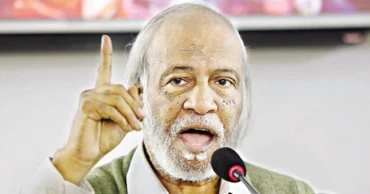
Neither parliament nor current govt was formed with people’s mandate: Dr Abdul Moyeen Khan
BNP leader Dr Abdul Moyeen Khan on Friday said neither the parliament nor the current government was formed with the mandate of the people of the country.
"We would like to say this clearly that the parliament and the government were not formed with the votes of people. So, it’s not the parliament of people and not the government of people,” he said.
Dr Moyeen, a standing committee member of BNP, came up with the remarks while distributing blankets among the destitute in front of the Jatiya Press club. Jatiyatabadi Textile Engineering Association of Bangladesh arranged the programme.
BNP, like-minded parties set to hold black-flag processions Friday, Saturday
He said the country’s people have turned down the government formed through the lopsided election without the participation of voters on January 7.
The BNP leader claimed that their party believes in the politics of people and it always works for ensuring the welfare and rights of the country’s people. “We’ll be there on the streets to stand by the people until we can bring back democracy for the 18 crore people of Bangladesh.”
He said the government may try to suppress people by force with guns, rifles and bullets, but ultimately it will be defeated to people.
New education policy, school curriculum are anti-national: Rizvi
Dr Moyeen said there was no election in Bangladesh on January 7 as a selection was done in the name of election from the capital. “Not only the BNP or the pro-democratic people of Bangladesh but also the voters belonging to Awami League did not participate in the election.”
He said the freedom fighters liberated Bangladesh for establishing democracy and ensuring the economic emancipation of poor people.
“The government built the Padma Bridge by spending Tk40,000 crores and it built the metro rail by spending Tk30,000 crores...I have a small question when you can spend Tk,40,000 and Tk30,000 crores (for mega projects) why can't you give a blanket of one hundred taka to the cold-hit people? Why do we (BNP) have to stand here and distribute blankets?” Dr Moyen said.
Rich-poor disparity rising due to lack of democracy: BNP leader Nazrul Islam
He said the ruling party leaders are plundering the country’s resources and siphoning off huge money abroad for making their second homes as they do not do politics for the welfare of the people.
2 years ago

How new MPs took oath when tenure of outgoing parliament not yet expired, questions BNP’s Farooque
BNP Chairperson’s Advisory Council member Zainul Abdin Farooque on Wednesday questioned the legitimacy of having 600 members of Parliament in the 300 seats of the Jatiya Sangsad (JS).
Speaking at a human chain programme, he also said the country’s people will oust the Awami League regime through a strong movement.
“There’re 600 MPs in now Bangladesh. The MPs of the (11th) parliament will in place until January 29. How is that possible?,” Farroque said.
BNP-Jamaat’s evil designs will go in vain: Hasan Mahmud
He said how the new MPs took oath when the tenure of the outgoing parliament is not yet expired. “Which law is written in the constitution that can allow them (new MPs) to be sworn in.”
The BNP leader said the Awami League government does not obey the constitution though it talks about the constitution to hold the election under a partisan administration.
“I would like to tell you (govt) do not insult the people of Bangladesh by talking about the constitution. Please, follow the constitution, step down and restore democracy,” he said.
'Low turnout indicates the pulse of the people': Rizvi
Gonotantra Forum arranged the human chain programme in front of the Jatiya Press Club to demand the unconditional release of BNP Chairperson Khaleda Zia, Secretary General Mirza Fakhrul Islam Alamgir, Standing Committee Members Mirza Abbas, Amir Khosru Mahmud Chowdhury and other jailed leaders and activists of the party.
Farroque, also the Opposition Chief Whip in the 9th Parliament, said the election that was held on January 7 was not an election as people boycotted it.
“The voters did not go to the polling stations.. It has been widely presented by the media in the country and abroad. It's a shame,” he observed.
Bangladeshi origin Scottish MP greets PM Hasina on her re-election
The BNP leader alleged that the government has been trying to subdue the opposition leaders and workers by resorting to repressive acts.
He said their party is committed to restore democracy and people’s all rights, including the right to vote by carrying out a movement on the streets.
“You (govt) will gain nothing by filing cases against our leaders and workers and jailing and repressing them. This regime can’t stay in power by holding such a fake and staged election, no matter how many tricks they resort to. People must unseat them through the movement,” he said.
2 years ago

Modi introduces historic bill guaranteeing third of parliament lower house seats for women
The Indian government has put forward a bill ensuring a third of seats for women in the lower house of the parliament and state assemblies.
The bill, which was initially presented in 1996, has been in the works for decades, amidst objections from various political parties, reports BBC.
Also read: Modi opponents boycott opening of new parliament building as PM reshapes India’s power corridor
Its return is likely to bolster the chances of the ruling Bharatiya Janata Party's (BJP) luck in national elections next May, it said.
The bill was introduced during the first session of the new Indian parliament, but it is still a long way from becoming law.
It would need the consent of both houses of the parliament and a majority of state legislatures, as well as the signature of the Indian president.
Also read: Silence on Manipur ethnic violence prompts no-confidence vote against Indian PM Modi
The reported proposals to raise the total number of seats might complicate implementation even further, the report said.
Indian Prime minister Narendra Modi lauded the proposed law and said it was a historic occasion for the country in his inauguration speech at the new parliament building.
"The world understands that only talking of women-led development is not enough. This is a positive step taken on that front," he told politicians as he appealed to them to support the bill.
He also took a shot at the opposition, claiming that the past Congress-led administrations had failed to pass the measure while they were in office.
Also read: Hasina, Modi agree to resolve outstanding bilateral issues through talks
"There have been discussions around women's reservations for years. We can say with pride that we have scripted history," he said.
Modi opened the new parliament building in May, but no business has been conducted there until now.
He convened a five-day special session, which began on Monday but was held in the old parliament building on the first day.
Members of the two houses gathered for a picture session in the old building on Tuesday morning, followed by a ceremony commemorating parliament's history in the Central Hall of the British-era structure.
They subsequently relocated to the new parliament, which was formally named as the Parliament House of India by the office of the lower house of parliament.
2 years ago